
NEW: Onshore Inspections
The Flux
A robust handheld system for corrosion detection and 3D mapping of unpiggable pipelines.
Discover the Flux
Inspect The Unpiggable
NEW: Onshore Inspections
A robust handheld system for corrosion detection and 3D mapping of unpiggable pipelines.
Discover the Flux →
NEW Service
Know how fast every coating defect corrodes, in µm/year, validated against excavations.
See how it works →
FREE: Whitepaper
How CMI separates protected steel from actively corroding steel, without excavation.
Download →Hydrostatic testing is a pressure test in which a pipeline section is filled with water and pressurised above its normal operating pressure for a set time. If the pipe holds, it can be assumed that no hazardous defects are present in the tested section. The test is used after construction and as an integrity assessment, especially where in-line inspection is not feasible.
On this page
At a glanceHow it worksWhat it provesLimitsWith CMIFAQ
| Test medium | Water. A test with air or inert gas is called a pneumatic test |
| Test pressure | Above the maximum operating pressure, for example at least 125% for US hazardous liquid pipelines |
| Duration | At least 4 hours for US hazardous liquid pipelines, at least 8 hours for US gas pipelines operating at 30% of SMYS or more |
| Proves | Strength and tightness at the time of the test |
| Requires | Line out of service, product displaced, water supply and disposal |
| Regulations | 49 CFR 192 Subpart J for gas, 49 CFR 195 Subpart E for hazardous liquids |
The section is taken out of service and the product is displaced with water. Pumps raise the pressure to the test pressure, which is held for a set time. A leak has to be found and repaired, and the test is repeated.
For hazardous liquid pipelines, US rules require at least 125% of the maximum operating pressure for at least 4 hours, and a further 4 hours at 110% where the piping cannot be inspected visually. Gas pipelines that operate at 30% of SMYS or more are strength tested for at least 8 hours.
A spike test adds a short period at a higher pressure, up to 139% of the maximum operating pressure for about half an hour. It is meant to clear cracks that could otherwise keep growing.
A passed test shows that the pipe and its field welds hold the test pressure. Defects that would fail at that pressure are either absent or have failed during the test. This gives a margin between test pressure and operating pressure.
This matters most for older pipe whose longitudinal seams have been susceptible to failure, and for cracks.
The test gives a pass or fail for one moment. It does not locate or size the defects that survived, and it says nothing about how fast they grow. Corrosion continues after the test.
The effort is high. The line is out of service, water has to be supplied and disposed of, and a failure during the test means a repair. Where the interruption is not acceptable and no pig can run, operators turn to direct assessment.
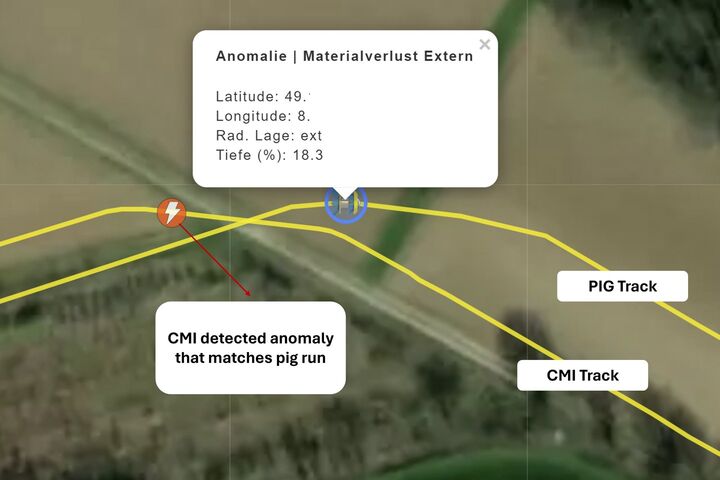
A hydrostatic test and EMPIT's Current Magnetometry Inspection (CMI) answer different questions. The test shows whether the pipe holds pressure today. CMI shows where the coating is damaged and how fast the steel is corroding at each of these defects, in µm per year.
CMI works from above ground. Nothing enters the pipe, no water is needed and the line stays in service. It does not measure wall thickness and does not replace a strength test. It tells the operator where corrosion is active between two assessments.
CMI vs. ILI compares the above-ground inspection with the third assessment method, in-line inspection.
A hydrostatic test uses water, a pneumatic test air or an inert gas. Compressed gas stores far more energy than a compressed liquid, so pneumatic tests are rarely used at higher pressures.
US rules require a hold time of at least 4 hours for hazardous liquid pipelines and at least 8 hours for gas pipelines operating at 30% of SMYS or more.
Only if the corroded area fails at test pressure. Corrosion that survives the test is neither located nor sized.
In-line inspection where the line is piggable, and direct assessment where it is not. Above-ground inspection with CMI adds a corrosion rate for every coating defect without taking the line out of service.
If you want to know what an above-ground inspection would show on your line, send us the length, diameter and location of the pipeline. We will tell you whether CMI fits and what a pilot section would look like.
Sources
Related terms
MAOPPressureIn-Line InspectionIntegrity ManagementPipeline RuptureTypes of CracksUnpiggable Pipeline
Read more

We use cookies to give you the best possible experience on our website and to improve our communication with you. We only use the data for which you have given us your consent, with the exception of the cookies that are absolutely necessary for the functionality of this website. For more information, please see our privacy policy. Make your choice here:
You can change your consent at any time by clicking on the Cookie Settings link in your footer.
Protects against cross-site request forgery attacks.
Saves the current PHP session.
Cookie from Google for website analytics. Generates statistical data about how visitors use the website. https://policies.google.com/privacy?hl=de