
NEW: Onshore Inspections
The Flux
A robust handheld system for corrosion detection and 3D mapping of unpiggable pipelines.
Discover the Flux
Inspect The Unpiggable
NEW: Onshore Inspections
A robust handheld system for corrosion detection and 3D mapping of unpiggable pipelines.
Discover the Flux
NEW Service
Know how fast every coating defect corrodes, in µm/year, validated against excavations.
See how it works
FREE: Whitepaper
How CMI separates protected steel from actively corroding steel, without excavation.
Download
There are seven practical ways to assess an unpiggable pipeline: make it piggable, run a tethered or robotic tool, pressure test it, apply direct assessment, screen it with guided waves, survey it with passive magnetometry, or inspect it from above ground with Current Magnetometry Inspection (CMI). They differ in what they need from the pipeline and in what they tell you. This guide compares all seven.
| Method | What it needs | In service? | What you learn |
|---|---|---|---|
| Make the line piggable, then run ILI | Launchers and receivers, replaced bends and fittings | After the rebuild | Wall loss and geometry along the whole line |
| Tethered or robotic in-line tools | An access point into the pipe, for example a hot-tap fitting | Depends on the tool | Wall loss on the section the tool reaches |
| Hydrostatic pressure test | Line filled with water | No | Pass or fail at the test pressure, no defect locations |
| Direct assessment (ECDA) with CIPS, DCVG, ACVG | Access along the route | Yes | Where the coating is damaged and how the cathodic protection performs |
| Guided wave ultrasonic testing (GWUT) | Direct contact with the pipe at a test point | Yes | Wall loss indications within a limited range of the test point |
| Passive magnetometry (LSM, MTM, MMM) | Access along the route | Yes | Zones of elevated mechanical stress |
| CMI above-ground inspection | Access along the route, cathodic protection test posts | Yes | Every coating defect, a corrosion rate for each one, position and depth of cover |
Around 40% of the world's pipelines cannot be inspected with in-line tools. If you first want the definition and the reasons, read What Is an Unpiggable Pipeline?
Installing launchers and receivers and replacing the bends and fittings that block a tool turns an unpiggable line into a piggable one. In-line inspection (ILI) then delivers wall loss and geometry for the whole line. The cost depends on how many obstacles there are and on knowing where they are.
On a hydrogen conversion project, the original plan with its excavation programme was estimated at around EUR 40 million. An above-ground CMI survey, which also identified the obstacles that would have stopped a pig, brought the total cost of the conversion to around EUR 15 million. Read the case.
BEST FOR Long transmission lines with few obstacles and decades of service ahead.
Tethered tools are pulled or driven into the line on a cable. Robotic tools move under their own power. The Explorer robots developed with US Department of Transportation funding, for example, run without a tether in live natural gas lines and carry a magnetic flux leakage sensor for metal loss. Both types need an access point into the pipe, and they inspect the section they can reach from it.
BEST FOR Short, critical sections where wall-loss data from inside the pipe is required.
The line is taken out of service, filled with water and pressurised above its operating pressure. The test proves the strength of the line on that day. It gives no defect locations, and it requires an outage and the handling of the test water.
BEST FOR Proof of strength where an outage is acceptable.
Direct assessment is a structured process in four steps: pre-assessment, indirect inspection, direct examination and post-assessment. For external corrosion (ECDA), the indirect inspection uses above-ground surveys such as CIPS, DCVG and ACVG. They find coating defects and show how the cathodic protection performs.
They do not show whether a defect is corroding, so operators dig to find out. In the DVGW NEMEK field study, 6,672 coating defects were assessed. Three of them were actively corroding. See ECDA for Unpiggable Pipelines: Where CMI Fits in the Four Steps.

Direct examination: the pipe is excavated to check what the above-ground survey indicated.
BEST FOR Coated, cathodically protected lines where operators already work to ECDA.
A ring of transducers is clamped onto the pipe and sends ultrasonic waves along the pipe wall. Reflections indicate changes in the cross-section, such as metal loss. The glossary explains guided wave testing in more detail.
US rules for gas transmission pipelines accept GWUT as an integrity assessment method under defined criteria. They put the inspection range at roughly 60 to 100 feet, depending on field conditions, and, in go/no-go mode, require every indication above the threshold to be examined directly, inspected in-line, pressure tested or replaced.
BEST FOR Cased crossings and other short sections next to an accessible point.
Large stand-off magnetometry (LSM) is a passive method. It is also known as the magnetic tomography method (MTM), metal magnetic memory (MMM) or stress concentration tomography. A technician or a drone carries magnetometers along the route and records the magnetic field of the pipe itself. Mechanical stress changes the magnetisation of steel, so the survey reports zones of elevated stress, for example from ground movement, bending, dents or defects. No connection to the pipeline is needed.
Published work describes LSM as a screening technology and reports its strongest signals for large-scale stress caused by geohazards. How it differs from CMI: CMI vs. LSM, MTM and MMM.
BEST FOR Screening long routes for geohazards and stress-related threats.
EMPIT developed Current Magnetometry Inspection (CMI) for unpiggable pipelines. An inspection current is fed into the pipeline through existing cathodic protection test posts. A technician walks the line with the Current Mapper, which measures the magnetic field of that current above the buried pipe. Water crossings are surveyed by boat, hard-to-reach terrain by drone.
Where the coating is damaged, part of the current leaves the pipe and enters the soil. CMI detects this current loss and locates the defect. A multi-frequency analysis then shows whether the steel is protected by a surface layer or is actively corroding. For every inspected section you receive:
The inspection is non-intrusive. Nothing enters the pipe, nothing is excavated for the survey, and the pipeline stays in service. Details: Unpiggable Pipeline Inspection from Above Ground.
BEST FOR Knowing which coating defects need action, without pigging, excavation or shutdown.
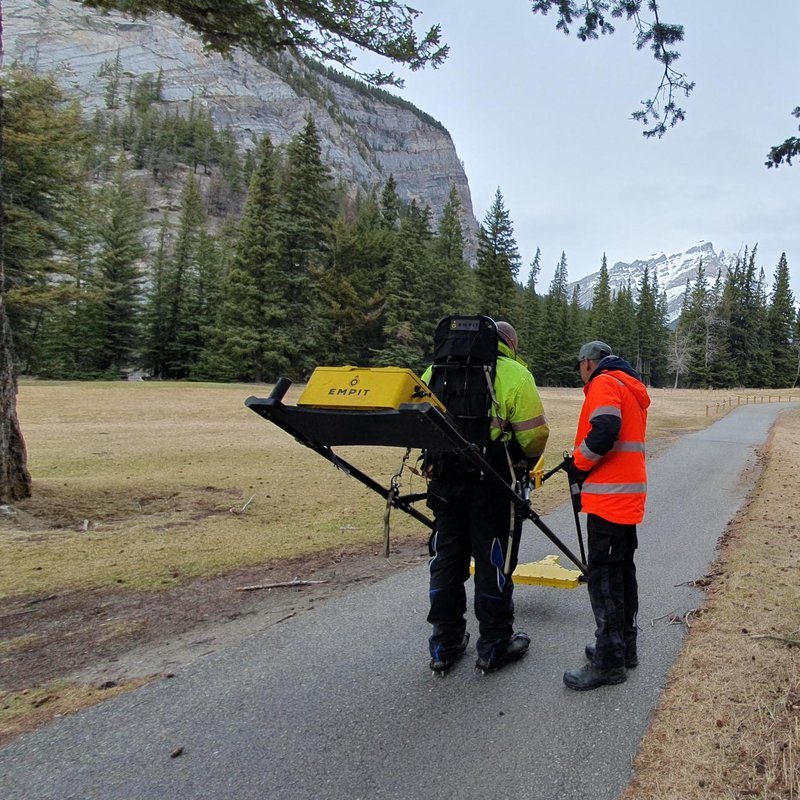
Walked along the route: A technician carries the handheld sensor system above the buried pipeline, across fields, roads and built-up areas.
What it records: The data for all CMI services, from coating defects and corrosion risk to 3D position and depth of cover.
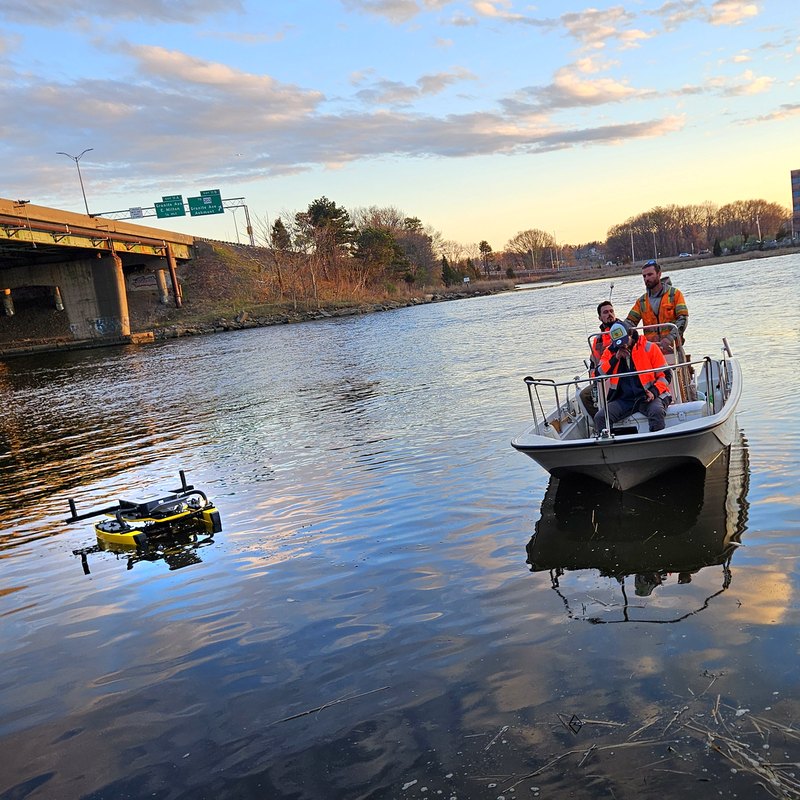
Built for water crossings: An autonomous inspection boat for pipelines in inland, nearshore and coastal waters.
What it records: Corrosion risk, a 3D profile of pipeline and riverbed, and the depth of cover below the water.
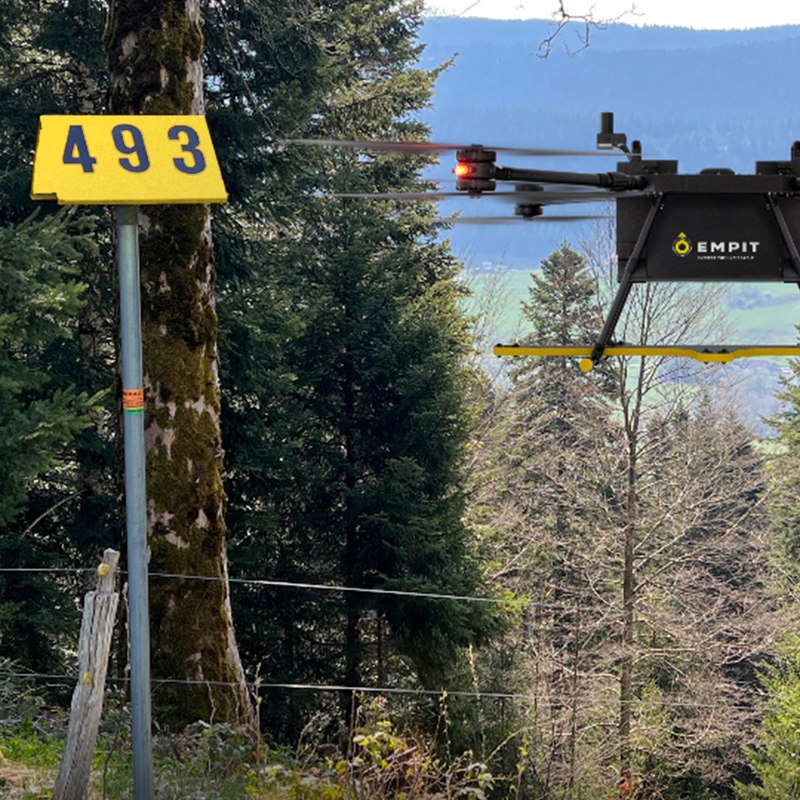
Built for ground nobody can walk: Steep slopes, water crossings and restricted zones are surveyed from the air.
What it records: 3D position, bending strain, pipe movement and depth of cover, quickly and without disruption.
Most integrity programmes combine methods. An above-ground survey of the whole line shows where the more expensive methods are worth their cost.
There is no single best method. Tools inside the pipe measure wall loss directly but need access or a rebuild. Above-ground methods cover the whole route while the pipeline stays in service. Which one fits depends on the threat you need to assess.
Direct assessment surveys, guided wave testing, passive magnetometry and CMI are carried out while the pipeline stays in service. Some robotic tools also run in live gas lines.
LSM, also known as MTM or MMM, is passive and reports mechanical stress. CMI is active: it measures the field of an inspection current and reports coating defects and their corrosion rate. Read the full comparison: CMI vs. LSM, MTM and MMM.
Send us the route of one unpiggable section. We will tell you what a CMI survey can deliver there.
Sources