
NEW: Onshore Inspections
The Flux
A robust handheld system for corrosion detection and 3D mapping of unpiggable pipelines.
Discover the Flux
Inspect The Unpiggable
NEW: Onshore Inspections
A robust handheld system for corrosion detection and 3D mapping of unpiggable pipelines.
Discover the Flux →
NEW Service
Know how fast every coating defect corrodes, in µm/year, validated against excavations.
See how it works →
FREE: Whitepaper
How CMI separates protected steel from actively corroding steel, without excavation.
Download →Explore how EMPIT transforms complex challenges into measurable outcomes.


Insights and research from EMPIT’S experts.
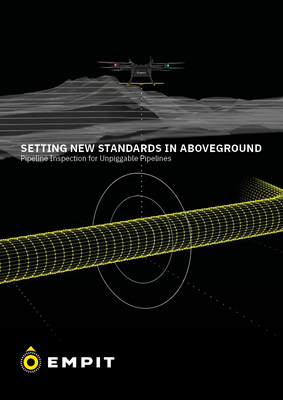
Roughly half of buried distribution and older transmission pipelines worldwide either lack the launch-and-receive infrastructure required or are limited by complex geometries for inline inspection (ILI) tools. These pipelines are thus, considered as “unpiggable”. This often applies to older pipelines that have in some cases already exceeded their original design lifetime. Since recurring inspections become increasingly important as pipelines age, innovative solutions are required to ensure their integrity and operational safety. This article delves into the advanced technologies and methodologies employed in the inspection and maintenance of unpiggable pipelines from above ground, highlighting the role of EMPIT and its groundbreaking Current Magnetometry Inspection (CMI) technology.
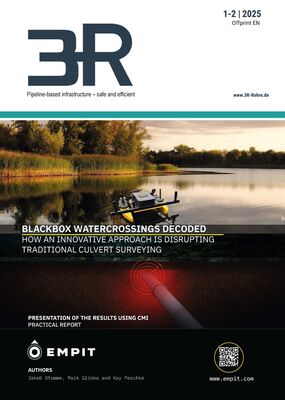
Pipelines known as culverts cross water bodies and other infrastructures such as roads. They pose a particular challenge for risk management. Especially when verifying the position and depth of cover (DoC) of pipelines crossing water bodies, conventional inspection methods reach their limits. The innovative inspection technology developed by EMPIT GmbH – Current Magnetometry Inspection (CMI) – now offers an alternative. The AI-supported process enables precise determination of pipeline position and it’s DoC. Practical examples from German network operators demonstrate the performance of the process.
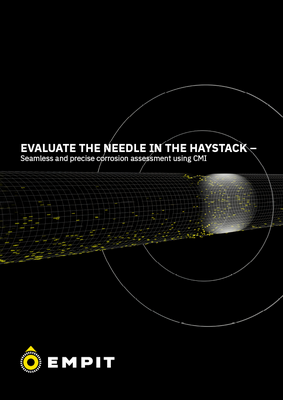
Roughly half of buried distribution and older transmission pipelines worldwide lack the launchand-receive infrastructure required for inline inspection (ILI) tools. To ensure also the integrity of these pipelines, EMPIT developed the Current Magnetometry Inspection (CMI). CMI is an aboveground inspection technique that enables detection of coating defects down to 1 mm² with pinpoint accuracy, while combining it with insights into local risk for active external corrosion at the steel surface at the located defects. Thus, from CMI also conclusions can be drawn on the local CP efficiency, and it does it with a much higher sensitivity and reliability compared to conventional over the line surveys; confirmed in direct comparisons in research projects.
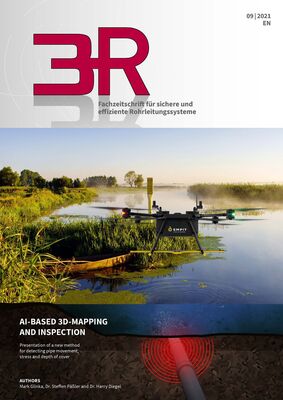
The article presents an alternative inspection technique for seamless, cost-efficient and accurate documentation that overcomes limitations of established methods and creates a new approach for the verification of as-built data of buried pipelines. Two case studies of large German pipeline operators show possible areas of application.
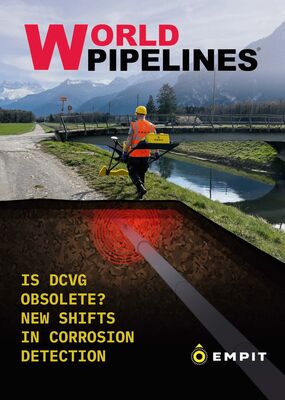
For the assessment of external corrosion protection, coating integrity evaluation methods are often carried out on buried pipeline systems. In contrast to the commonly used direct current voltage gradient measurement (DCVG), the newly developed current magnetometry inspection (CMI) offers significant advantages. For the operator, the question arises regarding the comparability of the methods. Therefore, measurements were carried out with both DCVG and CMI to draw conclusions about the transferability of the respective measurement results. These results and an evaluation are discussed in this article.
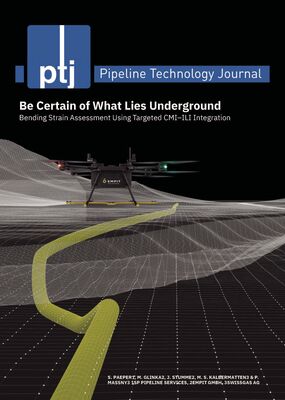
External pipeline inspection methods have been developed to support pipeline operators with their integrity management programs. The current magnetometry inspection (CMI) technique can be employed to detect pipeline features, in particular pipeline curvatures and displacements, which are critical for ensuring the safety and integrity of pipelines.
This paper shows how CMI can be a complement or, sometimes, even an alternative to detect minor displacements and to record changes in pipeline elevation due to ground movement or to track movements over time.
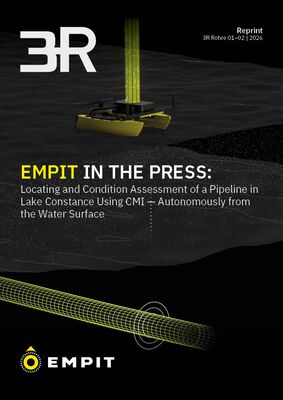
The newly developed CMI technology enables the precise locating and condition assessment of water-crossing pipelines beyond the limits of conventional methods. It captures position, depth of cover, bending strain, coating defects and corrosion risk externally and AI-supported — even at great depths, as this application case in Lake Constance demonstrates.
We use cookies to give you the best possible experience on our website and to improve our communication with you. We only use the data for which you have given us your consent, with the exception of the cookies that are absolutely necessary for the functionality of this website. For more information, please see our privacy policy. Make your choice here:
You can change your consent at any time by clicking on the Cookie Settings link in your footer.
Protects against cross-site request forgery attacks.
Saves the current PHP session.
Cookie from Google for website analytics. Generates statistical data about how visitors use the website. https://policies.google.com/privacy?hl=de