Know which coating defects
are actually corroding.
On unpiggable pipelines, EMPIT measures a corrosion rate in µm/year for every coating defect. From above ground, with the line in service.
coating defects assessed in the DVGW NEMEK field study
were actively corroding
were protected by working cathodic protection
Conventional surveys cannot tell which defects are corroding, so they dig to find out.
Up to 95% of those excavations are unnecessary. CMI shows you the few that actually matter.
The same coating defect
can be passivated, or corroding.
A coating is never perfect. At every holiday in it, what happens to the steel decides everything. Either a protective film seals the steel and stops corrosion, or bare steel meets the soil and loses metal. CMI tells the two apart, from the surface.
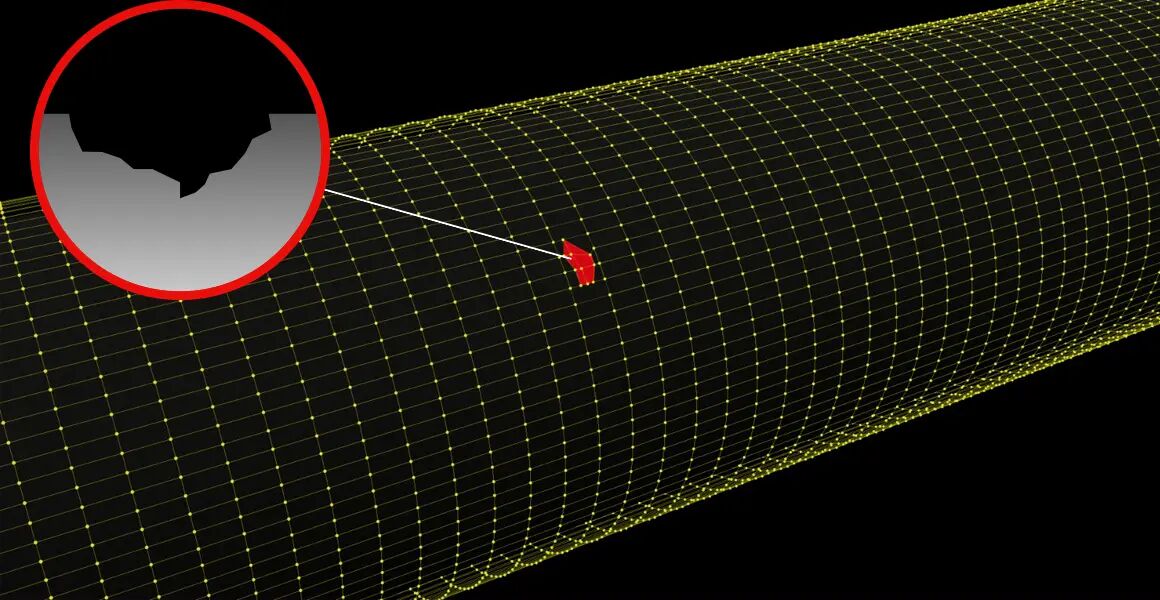
| Active · CR 3–CR 4 | as seen in CMI data |
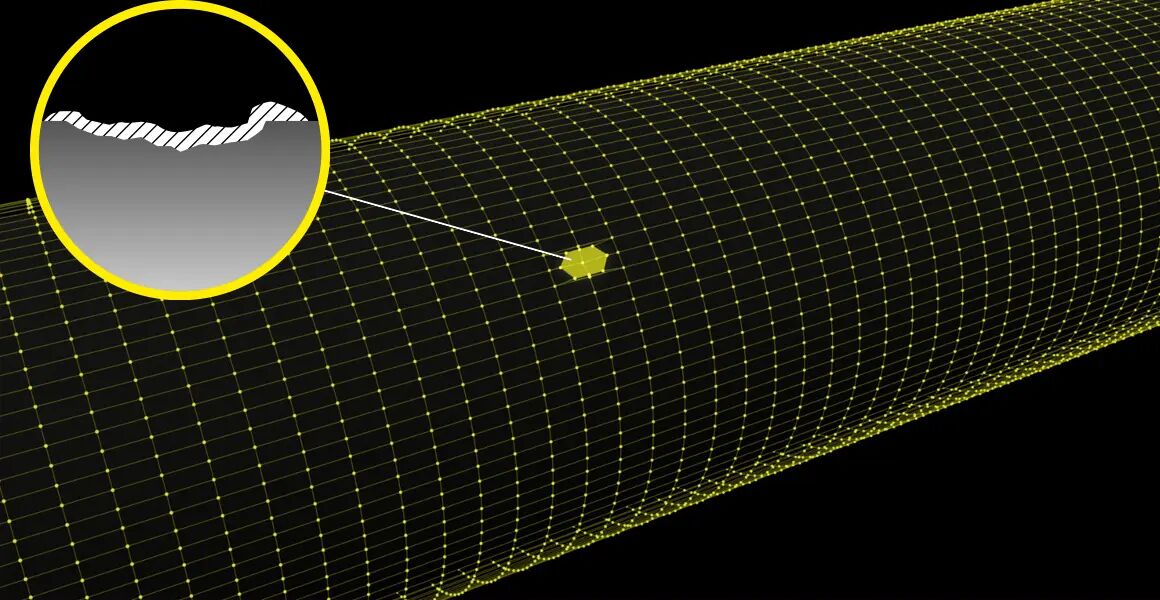
| Passivated · CR 0 | as seen in CMI data |
Finding a defect is not the same
as knowing it is corroding
Conventional surveys (DCVG, CIPS)
They have the ability to locate larger coating defects, but cannot tell a passivated defect from progressing metal loss. So crews dig to find out, mostly without finding anything relevant.
CMI
CMI locates coating defects down to <1mm² and gives the corrosion state for each one. Dig where steel is actually corroding, and nowhere else.
Let’s see it in detail:
| ILI | Conventional ECDA | CMI | |
|---|---|---|---|
| Operating Environment | limited | limited | any |
| Coating Damage | – | ✓ | ✓ |
| Defect / Anomaly Location | ✓ | – | ✓ |
| Accumulated Metal Loss | ✓ | – | – |
| Corrosion Rate | – | – | ✓ |
| CP Effectiveness | – | (✓) | ✓ |
| Threat / Condition | ILI | Conventional ECDA | CMI |
|---|---|---|---|
| Limitation | Pipe geometry and infrastructure | Electrical conductivity, sufficient ground to electrode contact, sufficient defect size, parallel infrastructure and stray current interference | Electrical conductivity |
| Detection of Anomaly Type | Pipe wall anomalies | Coating defects with sufficient surface voltage gradient | Coating defects down to < 1mm² |
| Anomaly Positioning | Relative position on pipe | Georeferenced location | Georeferenced location |
| Normative Assessment of CP Effectiveness | No | Using potential measurements according to
ISO 15589-1 / EN 12954 / NACE SP0169 |
Using potential measurements according to ISO 15589-1 / EN 12954 / NACE SP0169 |
| Identification of Corrosion Activity | No | No | Yes |
| Determination of Corrosion Rate | No | No | Corrosion rate classification in µm/year |
Independently validated
by the DVGW.
In the NEMEK field study, across 37 excavations on real European transmission pipelines, CMI assessed cathodic-protection effectiveness correctly in 94.6% of cases. The conventional methods it was benchmarked against managed only 27.8%, leaving most corrosion unflagged.
field excavations on real pipelines
correct assessment of CP effectiveness based on CMI
correct assessment of CP effectiveness based on conventional methods
Field study participants · European pipeline & network operators


























































Get what’s necessary
Corrosion Assessment
“What is the state of my pipeline?”
The full picture. All defects are reported and assigned to a Corrosion Activity Class, relating to a corrosion rate in µm/year.
Corrosion Screening
“What do I need to address now?”
Fast triage. Get only the defects with high or critical corrosion activity, georeferenced and prioritized.
Corrosion Screening · uncoated lines
“Where are the active hotspots?”
Corrosion hotspots. Get locations of high or critical corrosion activity on uncoated lines and bare steel.