
NEW: Onshore Inspections
The Flux
A robust handheld system for corrosion detection and 3D mapping of unpiggable pipelines.
Discover the Flux
Inspect The Unpiggable
NEW: Onshore Inspections
A robust handheld system for corrosion detection and 3D mapping of unpiggable pipelines.
Discover the Flux →
NEW Service
Know how fast every coating defect corrodes, in µm/year, validated against excavations.
See how it works →
FREE: Whitepaper
How CMI separates protected steel from actively corroding steel, without excavation.
Download →Depth of cover (DOC) is the vertical distance between the ground surface and the top of a buried pipeline. It protects the pipeline against excavation damage and surface loads. Depth of cover is set at construction, but it changes over time, so operators have to measure it again.
| Abbreviation | DOC |
| Measured from | Ground surface to the top of the pipe |
| Why it matters | Protection against third-party damage and external loads |
| Changes through | Erosion, agriculture, construction, river scour and settlement |
| Example requirement | 30 to 36 inches (762 to 914 mm) for buried gas transmission lines in normal soil under 49 CFR 192.327 |
| Measured by CMI | Continuously along the route, down to 7 m with standard equipment |
The soil above a pipeline is its protection against excavators, ploughs and traffic loads. A pipeline with too little cover is exposed to third-party damage and to loads it was not designed for. Depth of cover is therefore part of every design code and of the integrity management of buried pipelines.
Minimum cover is set by the design code that applies to the pipeline, for example ASME B31.8, CSA Z662 or AS 2885, and by national regulations. In the United States, 49 CFR 192.327 sets these minimum values for buried gas transmission lines in normal soil:
| Location | Minimum cover in normal soil |
|---|---|
| Class 1 locations | 30 inches (762 mm) |
| Class 2, 3 and 4 locations | 36 inches (914 mm) |
| Drainage ditches of public roads | 36 inches (914 mm) |
| Navigable river, stream or harbour | 48 inches (1,219 mm) |
These values apply at the time of construction. Less cover is allowed in consolidated rock.
Cover that was sufficient at construction does not stay that way. Erosion and river scour remove soil. Agriculture and land development change the surface. Ground settlement and pipeline movement change the position of the pipe. After years in the ground, the actual depth of cover is often unknown.
Traditionally, depth of cover is checked point by point with a pipe locator, or by probing and excavation. Current Magnetometry Inspection (CMI) measures it continuously. A technician walks the line with the Current Mapper, which records the magnetic field of an inspection current in the pipeline and locates the pipe in three dimensions. Water crossings are surveyed by boat, hard-to-reach terrain by drone.
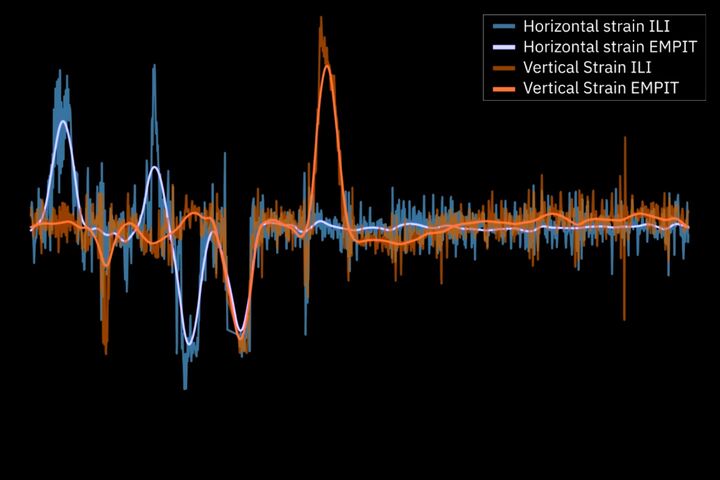
For every inspected section, EMPIT delivers a 2D and 3D pipeline scan with depth of cover. Standard equipment covers pipelines down to 7 m. The same survey shows coating defects with a corrosion assessment and the bending strain of the pipe. Read how this works at river crossings in Bending Strain on Unpiggable Pipelines.
To the top of the pipe. The depth to the pipe centre is larger by half the pipe diameter.
It depends on the code and the location. In the United States, 49 CFR 192.327 requires at least 30 inches of cover in Class 1 locations and 36 inches in Class 2, 3 and 4 locations for buried transmission lines in normal soil.
Yes. Above-ground methods locate the pipe and derive its depth from the surface. CMI does this continuously along the route while the pipeline stays in service.
Send us the length, diameter and location of your line. We tell you whether CMI fits and what a pilot section would look like.
Sources
Related terms
Pipeline MovementGeotechnical HazardsBending StrainPipeline InspectionCMIPipeline MappingRiver Crossing
Read more
21. November 2026
We use cookies to give you the best possible experience on our website and to improve our communication with you. We only use the data for which you have given us your consent, with the exception of the cookies that are absolutely necessary for the functionality of this website. For more information, please see our privacy policy. Make your choice here:
You can change your consent at any time by clicking on the Cookie Settings link in your footer.
Protects against cross-site request forgery attacks.
Saves the current PHP session.
Cookie from Google for website analytics. Generates statistical data about how visitors use the website. https://policies.google.com/privacy?hl=de