
NEW: Onshore Inspections
The Flux
A robust handheld system for corrosion detection and 3D mapping of unpiggable pipelines.
Discover the Flux
Inspect The Unpiggable
NEW: Onshore Inspections
A robust handheld system for corrosion detection and 3D mapping of unpiggable pipelines.
Discover the Flux
NEW Service
Know how fast every coating defect corrodes, in µm/year, validated against excavations.
See how it works
FREE: Whitepaper
How CMI separates protected steel from actively corroding steel, without excavation.
Download
Current Magnetometry Inspection (CMI) and large stand-off magnetometry (LSM) both inspect buried pipelines from above ground with magnetometers. LSM is also known as the magnetic tomography method (MTM) or metal magnetic memory (MMM). The two approaches measure different things. LSM, MTM and MMM are passive and look for mechanical stress in the pipe wall. CMI is active: it measures the magnetic field of an inspection current and shows where the coating is damaged and whether the steel underneath is corroding.
| LSM, MTM, MMM | CMI | |
|---|---|---|
| Principle | Passive. Measures the magnetic field of the pipe itself, which changes with mechanical stress | Active. Measures the magnetic field of an inspection current fed into the pipeline |
| Connection to the pipeline | None | Existing cathodic protection test posts |
| Main result | Zones of elevated mechanical stress | Every coating defect and a corrosion rate for each one |
| Geometry | Pipeline route and depth of cover | 2D and 3D pipeline scan with depth of cover, bending strain and pipe movement |
| Coating and cathodic protection | Covered by separate surveys such as CIPS and DCVG | Coating defects and corrosion rate come from the same survey |
| Typical use | Screening for geohazards and stress-related threats | Deciding which coating defects need action |
| Pipeline in service | Yes | Yes |
Passive above-ground magnetometry is offered under several names. They differ by provider and region.
| Name | Stands for | Background |
|---|---|---|
| LSM | Large stand-off magnetometry | The general term in industry and research papers |
| MTM | Magnetic tomography method | Developed by Transkor-K and described in several patents. A validation programme by NYSEARCH describes it as passive: no electric signal and no magnetic excitation is applied to the pipe |
| MMM | Metal magnetic memory | A non-destructive testing technique with its own standard, ISO 24497. Applied from above ground it is also called non-contact magnetometric diagnostics (NMD) |
| SCT | Stress concentration tomography | A screening tool in the same category |
The principle is the same in each case. The sensors record the magnetic field that the steel pipe has in the earth's field, and the evaluation looks for anomalies caused by mechanical stress. In this article, LSM stands for the whole group.
Steel is ferromagnetic. In the earth's magnetic field, a buried steel pipe carries a magnetic field of its own. Mechanical stress changes the magnetisation of the steel. This is called inverse magnetostriction, or the Villari effect.
An LSM survey records the magnetic field above the pipeline with an array of magnetometers, carried by a technician or a drone. Software searches the data for anomalies and translates them into zones of elevated stress. Sources of such stress include ground and slope movement, bending, dents, wrinkles and other defects in the pipe wall.
LSM applies no signal and needs no connection to the pipeline. Published work describes it as a screening technology. A paper at the ASME International Pipeline Conference 2020 reports the strongest signals for large-scale stress caused by geohazards, and names consistency for small, localised anomalies as the main open challenge at that time.
Passive magnetometry (LSM, MTM, MMM): the sensors record the magnetic field of the pipe itself. No signal is applied. The result is a list of locations with elevated mechanical stress.
EMPIT developed Current Magnetometry Inspection (CMI) for unpiggable pipelines. An inspection current is fed into the pipeline through existing cathodic protection test posts. A technician walks the line with the Current Mapper, which measures the magnetic field of that current above the buried pipe. Water crossings are surveyed by boat, hard-to-reach terrain by drone.
Because the signal is applied, it is known. Where the coating is damaged, part of the current leaves the pipe and enters the soil. CMI detects this current loss and locates the defect. A multi-frequency analysis then shows whether the steel is protected by a surface layer or is actively corroding.
Active magnetometry (CMI): an inspection current is fed into the pipe and its magnetic field is measured above ground. Where current leaves the pipe, the coating is damaged.

CMI survey on land. The Current Mapper measures the magnetic field of the inspection current above the buried pipe.
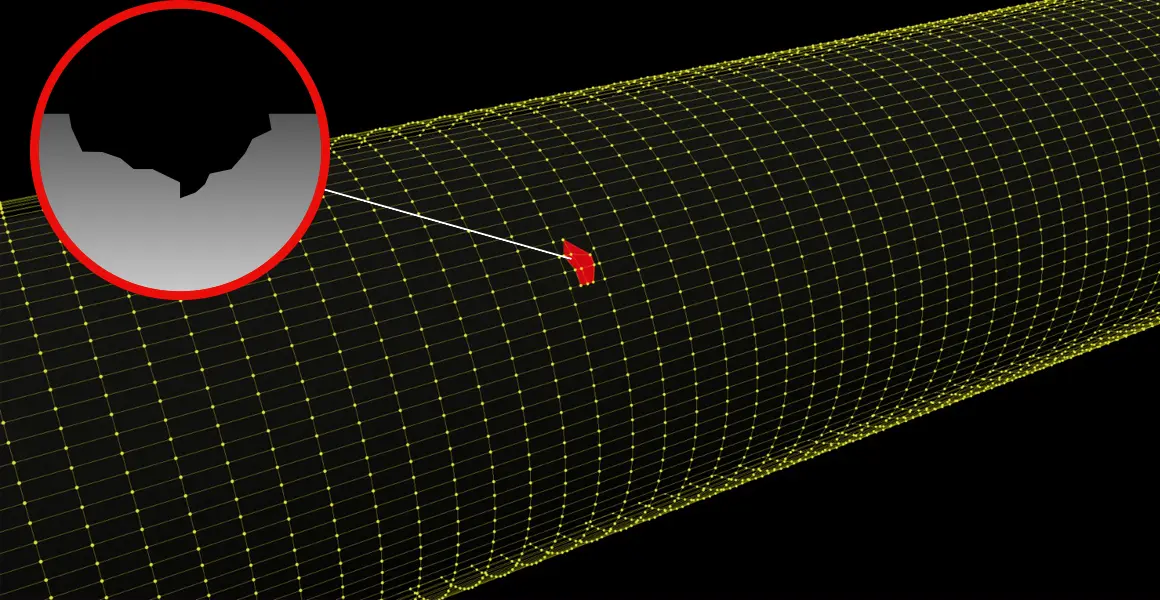
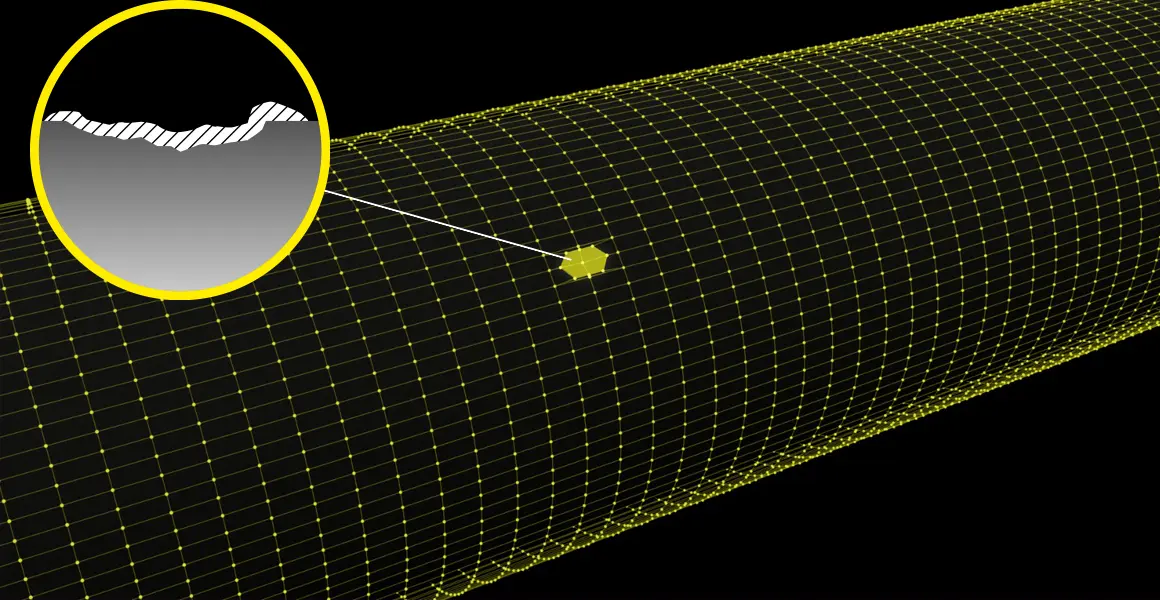
CMI separates actively corroding coating defects from passivated ones.
The two methods answer different questions. External corrosion on a coated, cathodically protected pipeline is an electrochemical process at a coating defect. CMI measures the current at that defect. LSM measures stress, not current, so coating condition and cathodic protection are covered by separate surveys such as CIPS and DCVG.
In the DVGW NEMEK field study, 6,672 coating defects were assessed with CMI. Three of them were actively corroding. In a blind test with North America's largest energy company, nobody told the inspection team where the defects were. All thirteen were found from the surface, with no false calls. On another unpiggable line, CMI found 80% wall loss that potential surveys had missed.
EMPIT inspects more than 10,000 km of pipeline a year, with teams in Europe and the USA.
No. All of them are above-ground magnetometry methods, but LSM, MTM and MMM are passive and report mechanical stress. CMI is active and reports coating defects, their corrosion rate and the geometry of the pipeline.
No. Both surveys are carried out from above ground while the pipeline stays in service. Nothing enters the pipe.
Above-ground surveys are the indirect inspection step of ECDA. Operators who work to ECDA use CMI as a complementary indirect inspection tool. See where CMI fits in the four ECDA steps.
Send us the route of one section. We will tell you what a CMI survey can deliver there.
Sources