
NEW: Onshore Inspections
The Flux
A robust handheld system for corrosion detection and 3D mapping of unpiggable pipelines.
Discover the Flux
Inspect The Unpiggable
NEW: Onshore Inspections
A robust handheld system for corrosion detection and 3D mapping of unpiggable pipelines.
Discover the Flux
NEW Service
Know how fast every coating defect corrodes, in µm/year, validated against excavations.
See how it works
FREE: Whitepaper
How CMI separates protected steel from actively corroding steel, without excavation.
Download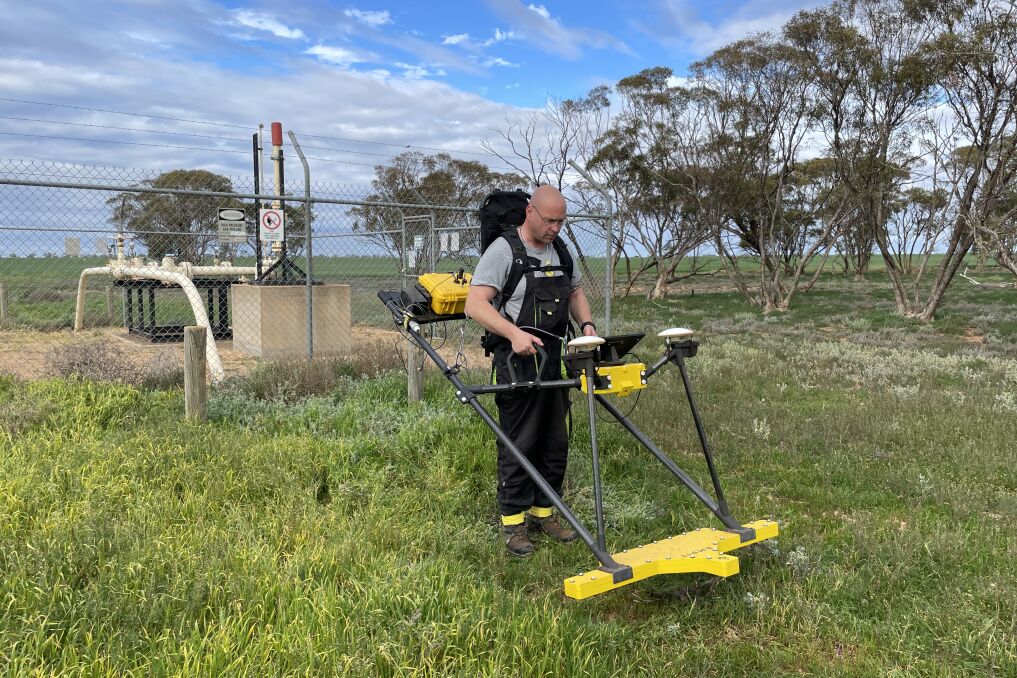
For unpiggable pipelines, External Corrosion Direct Assessment (ECDA) is often the main way to assess the threat of external corrosion. The process defined in AMPP SP0502 has four steps: preassessment, indirect inspection, direct examination and post assessment. Its weak point is the indirect inspection: the classic potential gradient surveys find coating holidays, but they do not tell the operator whether the steel underneath is corroding. This article explains where Current Magnetometry Inspection (CMI) fits into each ECDA step, why it qualifies as a complementary indirect inspection tool, and what validation data operators can point to when they add it to their ECDA plan.
Where no in-line inspection tool can pass, the operator has to assess the pipe wall without seeing it from the inside. ECDA does this by combining records, above-ground surveys and targeted excavations. In the United States, 49 CFR 192.925 describes ECDA as a four-step process and requires gas transmission operators to follow NACE SP0502 and ASME B31.8S when they use it.
The quality of an ECDA programme therefore depends heavily on what the above-ground surveys can see. Every excavation that finds intact steel costs money, and every corroding defect the surveys miss stays in the ground until the next assessment.
The two indirect inspection tools are meant to complement each other, not to measure the same thing twice. CIPS, intensive measurement (IM), a variant of CIPS that is widely used in Germany, and direct current voltage gradient (DCVG) surveys are all potential gradient methods. They depend on the voltage gradient that a coating holiday produces at the soil surface, and small gradients go undetected. Our case of 80% wall loss that potential surveys missed shows what that means in practice.
Current Magnetometry Inspection (CMI) measures and records the magnetic field of the electrical inspection current flowing along a conductive pipeline, from above ground and without direct contact. Where the coating is damaged, at a so-called coating holiday, part of that current leaves the pipe and enters the soil. CMI detects this current loss and locates the coating holiday. A multi-frequency analysis of each defect then indicates whether the steel is protected by a surface layer or exposed to active corrosion, and classifies each defect by its corrosion rate. Because CMI uses a different physical principle, it complements potential gradient surveys instead of duplicating them. And since EMPIT records CIPS, CAM and ACVG in parallel with CMI, the operator gets both perspectives from the same survey, without separate field campaigns.
CMI is not explicitly listed in Appendix A of NACE SP0502. For indirect inspection methods outside that list, 49 CFR 192.925 requires the operator to demonstrate the method's applicability, validation basis, equipment, application procedure and use of the data. Two independent data sets support that documentation for CMI:
The blind test also documents a limit operators should plan for: defects spaced closer than the method's 2 m (6.6 ft) spatial resolution are reported as one combined feature. The location is correct, but the individual count is only established during direct examination.
ECDA is often the most practical integrity assessment for unpiggable pipelines, and its results are only as good as the indirect inspection behind them. CMI contributes to all four steps: mapping data for preassessment, several complementary indirect inspection tools in one survey, corrosion state classification for ranking excavations, and measured corrosion rates as additional input for post assessment. NEMEK and the Enbridge blind test give operators a documented validation basis for adding it to their ECDA plan.
Two tools that both measure surface gradients are not really two perspectives. ECDA works best when one of them looks at the steel.