

CMI Found 80% Wall Loss on an Unpiggable Pipeline That Potential Surveys Missed
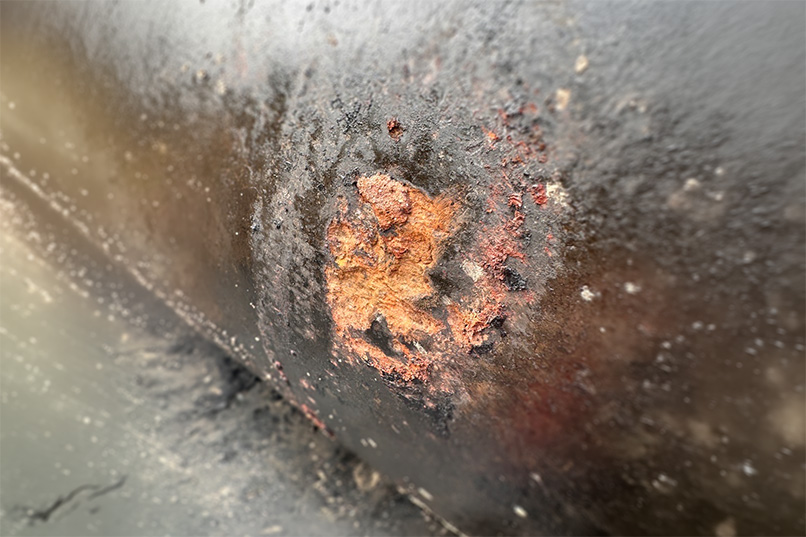
For years, potential surveys on an unpiggable pipeline showed no sign of trouble at one particular location. An above-ground Current Magnetometry Inspection (CMI) survey by EMPIT pointed to a coating defect at exactly that spot. The excavation confirmed it: severe external corrosion with a wall loss of 80%. The case shows what potential gradient surveys such as CIPS can and cannot tell an operator about the steel beneath the coating.
Unpiggable, so potential surveys had to carry the load
The pipeline cannot be inspected with in-line inspection (ILI) tools. Like many unpiggable pipelines, its integrity management therefore relies on cathodic protection (CP) and above-ground surveys. The operator carried out intensive measurement (IM) at regular intervals. IM is a variant of the close interval potential survey (CIPS) that is widely used in Germany. Like CIPS, it records the pipe-to-soil potential at close spacing along the route; in addition, it evaluates the voltage gradients at the soil surface to locate coating defects and assess the IR-free potential.
At the location in question, the intensive measurement results gave no reason for concern.
What CMI found
CMI measures and records the magnetic field of the electrical inspection current flowing along a conductive pipeline, from above ground and without direct contact. Where the coating is damaged, at a so-called coating holiday, part of that current leaves the pipe and enters the soil. CMI detects this current loss and locates the coating holiday. A multi-frequency analysis of each defect then indicates whether the steel is protected by a surface layer or exposed to active corrosion, and classifies each defect by its corrosion rate.
At this location, CMI identified a coating defect, associated it with a high risk of active corrosion and flagged it for excavation. When the pipe was exposed, the coating had failed and the steel showed deep external corrosion. The wall loss reached 80%.
Why a clean CIPS profile is not proof of intact steel
CIPS and intensive measurement are established methods for assessing cathodic protection along a pipeline. Like all potential gradient methods, however, they depend on the voltage gradient that a coating holiday produces at the soil surface. At this location, the resulting voltage gradient on the surface was too small to be detected. The defect therefore remained invisible in the potential surveys, while the steel beneath it continued to corrode.
CMI does not rely on this surface signal. It measures the magnetic field of the inspection current along the pipe itself, so the current loss at a coating holiday remains detectable even where the voltage gradient at the surface is negligible.
The DVGW research project NEMEK quantified this limitation on the pipelines of six European gas transmission operators. For the IR-free potential, intensive measurement produced a false negative rate of 68.4%, compared with 4.5% for CMI.
What this means for operators of unpiggable pipelines
Without ILI data, the above-ground survey is often the only source of information on the condition of the pipe wall. If that survey detects only some of the coating defects, typically the larger ones, and checks only the protection level, a clean result can create confidence that the steel does not justify.
CMI adds the missing information. It detects coating holidays and classifies the corrosion state at each defect in a single, non-intrusive above-ground inspection, without interrupting operation or the cathodic protection. Operators can then focus excavations on the defects that matter instead of relying on potential readings alone.
Conclusion
On this unpiggable pipeline, years of inconspicuous potential surveys stood above a coating holiday with 80% wall loss. CMI found it from above ground. The case shows how much potential surveys depend on what reaches the soil surface: where the voltage gradient is too small, they see nothing, whatever the condition of the steel beneath.
A potential survey only sees what reaches the surface. Corrosion does not have to.
Want to know the state of your steel, not just your potentials? Let's talk.