

Successful Blind Test with North America's Largest Energy Company
Nobody told the inspection team where defects were. All thirteen were found from the surface, with no false calls and no excavation.
A large share of the world’s buried pipelines cannot be inspected with in-line tools. Gathering lines, flowlines, distribution networks and older transmission segments were never built for pigging. For those assets, integrity management of an unpiggable pipeline falls back on above-ground surveys and targeted digs.
The problem is what those surveys can and cannot tell you. DCVG, ACVG and CIPS find coating holidays. They do not tell you whether the steel underneath is actually corroding, so operators dig on suspicion. One field study covering roughly 300 km (186 mi) of pipeline and 200 excavations found no meaningful correlation between conventional ECDA assessment criteria, such as IR-free potential or CP on-potential, and measured corrosion depth. In 43 % of the excavated locations there was no corrosion at all, regardless of the ECDA indication.
What Current Magnetometry Inspection measures
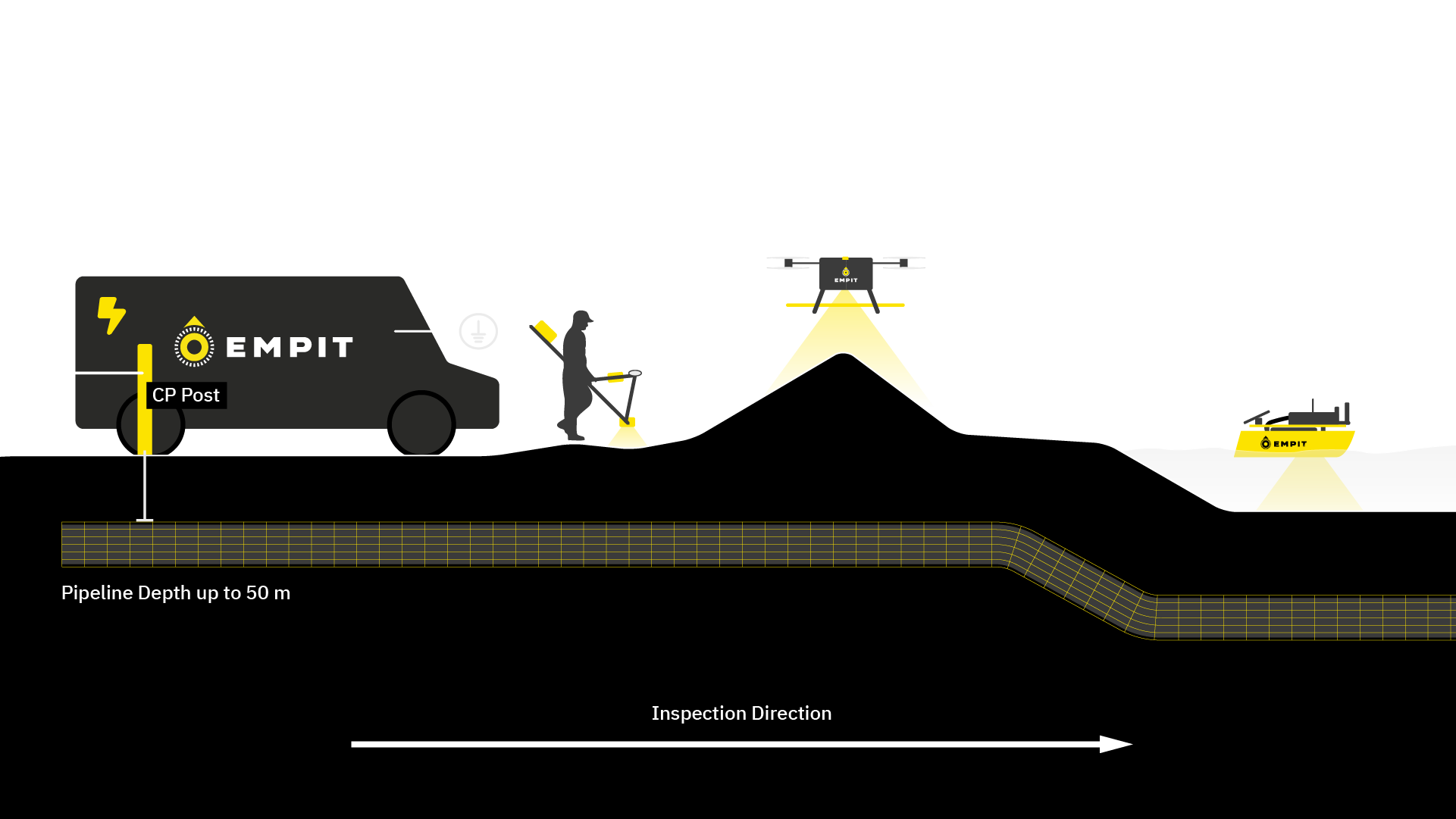
Current Magnetometry Inspection (CMI) was developed to close that gap. A multi-frequency AC signal is injected into the pipeline through an existing CP test lead, and the resulting magnetic field is measured from the ground surface. Coating damage lets current leak into the soil, which perturbs the field. Critically, the way that perturbation behaves across frequency indicates whether the exposed steel is behaving like an actively corroding surface or a passivated one, which is the basis of CMI’s corrosion state classification.
The blind test
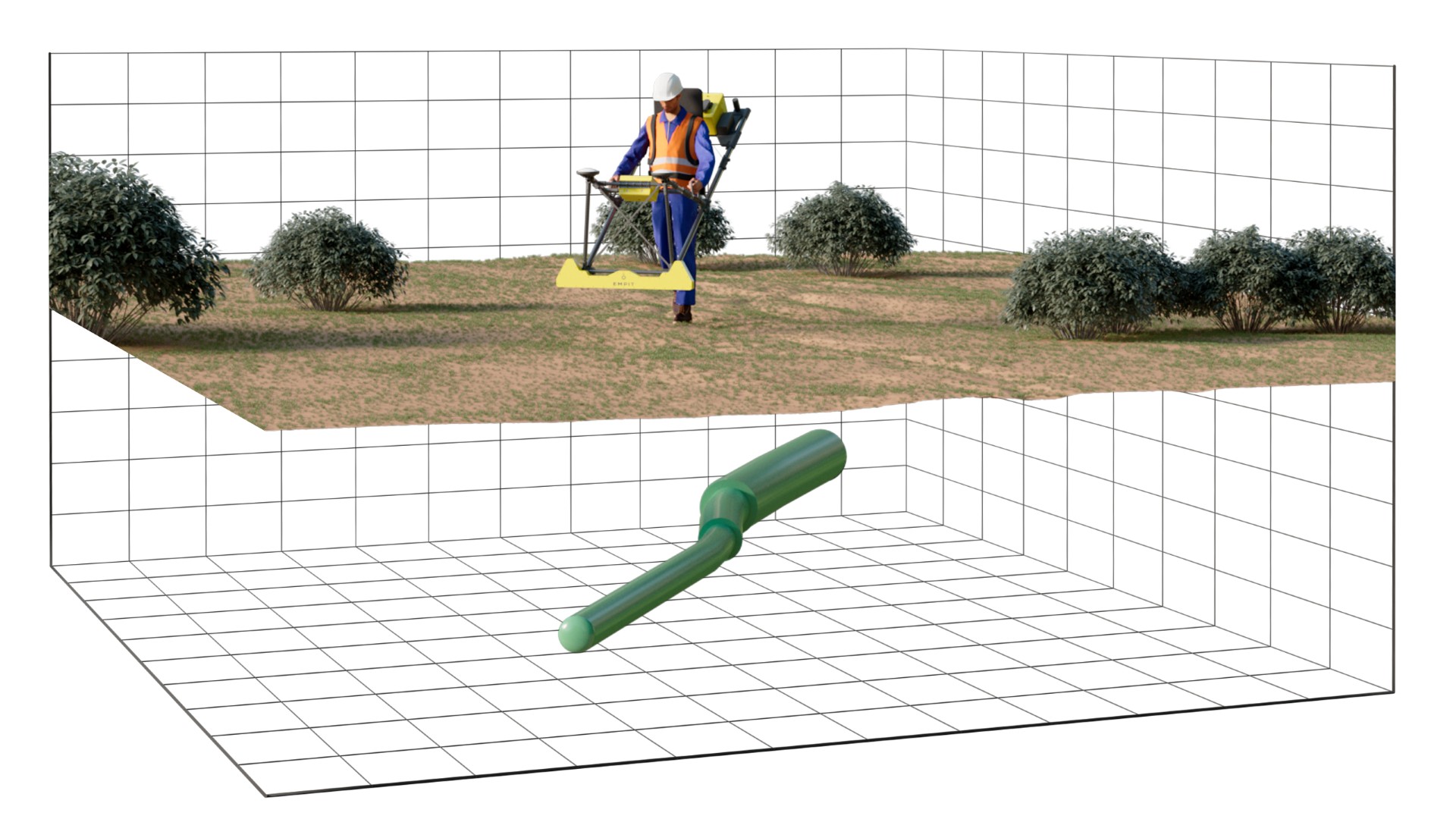
To test this in practice, a controlled blind validation was carried out with Enbridge, with Acuren acting as independent third party for defect fabrication and ground-truth documentation. A 45 m (148 ft) spool with two bends and three diameters (16, 22 and 30 in.) was fabricated and buried 1.2 to 1.5 m (4 to 5 ft) deep in an open field.
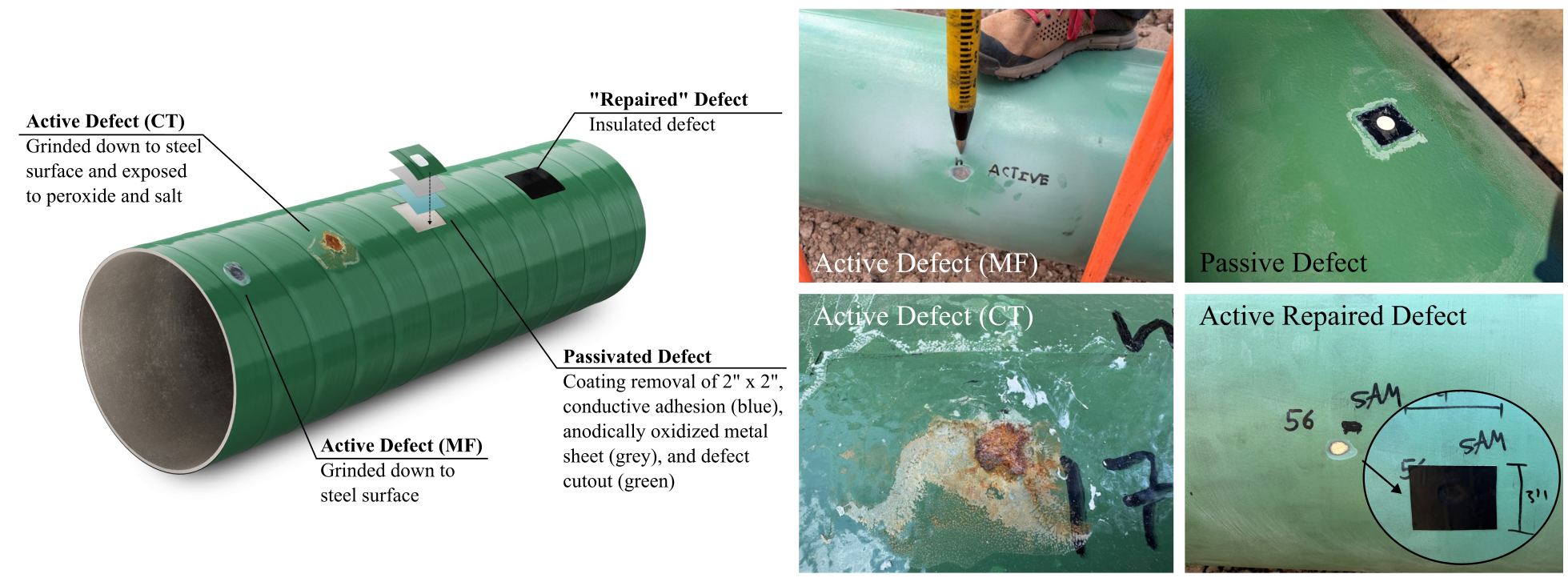
Twenty features were fabricated on the spool. Six were known control defects, used up front to confirm that a steel-electrolyte interface was present and that ground truth had not shifted during backfill. Thirteen were blind detectable defects, nine of them representing active corrosion and four passivated. The twentieth feature was a simulated repair, sealed with thick electrical tape to restore electrical isolation. Because a repaired coating is no longer a detectable defect, it is excluded from the detection count and instead tests the opposite property: whether the survey correctly reports nothing there. Locations, dimensions and corrosion states were documented independently and withheld from the inspection team.
What came back
All thirteen blind detectable defects were found. Nothing was reported where no defect had been fabricated, and no indication was raised at the simulated repair, so the survey produced no false calls. False call rate is the detection metric used in API 1163 and comparable qualification standards.
Reported positions fell within ±16 to ±55 cm (±6 to ±22 in.) of the documented locations, well inside a typical bell-hole excavation length. Three of the thirteen defects were spaced closer together than the method’s stated 2 m (6.6 ft) spatial resolution. As expected, they were reported as one combined feature rather than three separate ones: the survey flagged the location correctly, but the individual defect count there could only be established during direct examination. That is a physical limit of the resolution, not a detection failure, and it is the reason defect spacing in a validation programme should be set deliberately.
That leaves ten defects that were resolved individually and could therefore be classified by corrosion state. Every classification issued at medium or high data confidence proved correct. The three that did not match ground truth all carried low data confidence, showing the technology's quality assessment method.
That leaves ten defects that were resolved individually and could therefore be classified by corrosion state. Every classification issued at medium or high data confidence proved correct. The three that did not match ground truth all carried low data confidence. The confidence rating therefore did its job: the method flagged its own weak calls instead of presenting them with unwarranted certainty.
At a glance
- 45 m (148 ft) test spool, three diameters, two bends, buried 1.2 to 1.5 m (4 to 5 ft) deep
- 20 fabricated features: 6 known controls, 13 blind detectable defects, 1 simulated repair
- All 13 blind defects detected from the surface, across coated pipe, bends and girth welds
- No false calls, including at the simulated repair, where nothing was reported
- Location accuracy ±16 to ±55 cm (±6 to ±22 in.), RMS error 36 cm (14 in.)
- Of the 10 individually resolved defects, every classification rated medium or high confidence was correct
Why this matters
ECDA and SCCDA procedures were written around the technologies available at the time. Those technologies detect coating damage rather than corrosion activity, and they rely mainly on defects that produce a significant potential gradient. These large gradients are often a consequence of adequate cathodic protection rather than of corrosion. The DVGW NEMEK study quantified the same gap across 6,672 coating defects on operating pipelines. CMI can detect defects that conventional ECDA barely registers, and classify them by corrosion state. Separating an active defect from a passivated one supports a more genuinely risk-based excavation ranking than a coating-based one. On piggable lines, the same information can be used for screening or prioritization after an ILI run.
Coating damage tells you there is a pathway. It does not tell you whether anything is happening. That difference is what decides where you dig.
Read the full study
The complete validation study, including the defect listing, the localisation error distribution and the classification confidence matrix, will be presented at IPCE 2026 (Calgary, 21 to 25 September 2026), ADIPEC 2026 and AMPP 2027. For answers to common questions about CMI, see our FAQ.
Got a line you cannot pig? Talk to us about what is really under your right of way.