
NEW: Onshore Inspections
The Flux
A robust handheld system for corrosion detection and 3D mapping of unpiggable pipelines.
Discover the Flux
Inspect The Unpiggable
NEW: Onshore Inspections
A robust handheld system for corrosion detection and 3D mapping of unpiggable pipelines.
Discover the Flux →
NEW Service
Know how fast every coating defect corrodes, in µm/year, validated against excavations.
See how it works →
FREE: Whitepaper
How CMI separates protected steel from actively corroding steel, without excavation.
Download →Large standoff magnetometry (LSM) is a passive above-ground inspection method for buried steel pipelines. Magnetometers record the magnetic field of the pipe itself, and the evaluation looks for anomalies caused by mechanical stress in the pipe wall. No signal is applied and nothing is connected to the pipeline. The same principle is offered as the magnetic tomography method (MTM), metal magnetic memory (MMM) and stress concentration tomography (SCT).
On this page
At a glanceHow it worksState of the methodLSM and CMIFAQ
| Principle | Passive. Measures the magnetic field that the steel pipe has in the earth's field |
| Physical effect | Mechanical stress changes the magnetisation of steel: inverse magnetostriction, or the Villari effect |
| Result | Zones of elevated mechanical stress, plus route and depth of cover of the line |
| Other names | MTM, MMM, SCT |
| Connection to the pipeline | None |
| Typical use | Screening for geohazards and stress-related threats |
| Not in the result | Coating defects, cathodic protection, corrosion rate |
Steel is ferromagnetic. In the earth's magnetic field, a buried steel pipe carries a magnetic field of its own. Mechanical stress changes the magnetisation of the steel.
An LSM survey records this field above the pipeline with an array of magnetometers, carried by a technician or a drone. Software searches the data for anomalies and translates them into zones of elevated stress. Sources of such stress include ground movement, bending, dents and wrinkles.
Published work describes LSM as a screening technology. A paper at the ASME International Pipeline Conference 2020 reports the strongest signals for large-scale stress caused by geohazards, and names consistency for small, localised anomalies as the main open challenge at that time.
Both methods use magnetometers above ground. EMPIT's Current Magnetometry Inspection (CMI) is active: an inspection current is fed into the pipeline through existing cathodic protection test posts, and its magnetic field is measured. Because the signal is applied, it is known.
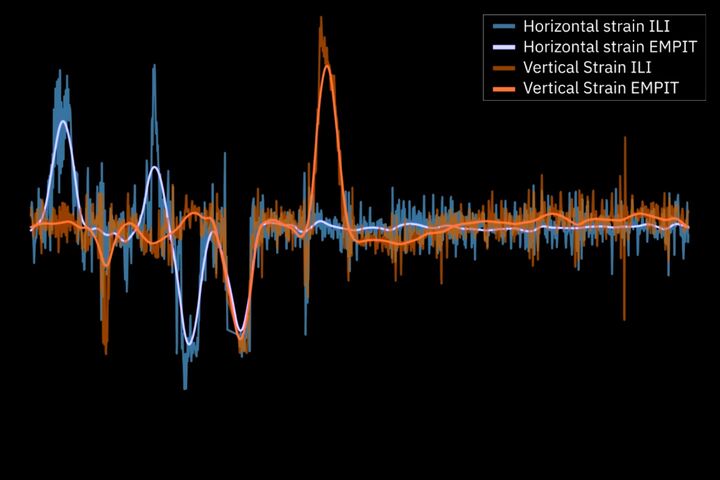
The results differ accordingly. LSM reports where the pipe is under stress. CMI reports every coating defect with a corrosion rate in µm per year, and the 3D position of the pipe with depth of cover, bending strain and pipe movement.
LSM needs no electrical access. CMI needs test posts or another contact point to feed in the current. CMI vs. LSM, MTM and MMM compares the two in detail.
A passive above-ground method that records the magnetic field of a buried steel pipeline and looks for anomalies caused by mechanical stress.
They rest on the same principle and differ by provider and region. MMM is also a non-destructive testing technique with its own standard, ISO 24497.
LSM reports zones of mechanical stress. It does not measure coating condition, cathodic protection or a corrosion rate.
No. CMI is active. It measures the magnetic field of an inspection current and reports coating defects, their corrosion rate and the geometry of the pipeline.
If you want to know what an above-ground inspection would show on your line, send us the length, diameter and location of the pipeline. We will tell you whether CMI fits and what a pilot section would look like.
Sources
Related terms
Geotechnical HazardsBending StrainPipeline MovementDepth of CoverCMIDrone InspectionNDT
Read more

21. November 2026
We use cookies to give you the best possible experience on our website and to improve our communication with you. We only use the data for which you have given us your consent, with the exception of the cookies that are absolutely necessary for the functionality of this website. For more information, please see our privacy policy. Make your choice here:
You can change your consent at any time by clicking on the Cookie Settings link in your footer.
Protects against cross-site request forgery attacks.
Saves the current PHP session.
Cookie from Google for website analytics. Generates statistical data about how visitors use the website. https://policies.google.com/privacy?hl=de