
NEW: Onshore Inspections
The Flux
A robust handheld system for corrosion detection and 3D mapping of unpiggable pipelines.
Discover the Flux
Inspect The Unpiggable
NEW: Onshore Inspections
A robust handheld system for corrosion detection and 3D mapping of unpiggable pipelines.
Discover the Flux →
NEW Service
Know how fast every coating defect corrodes, in µm/year, validated against excavations.
See how it works →
FREE: Whitepaper
How CMI separates protected steel from actively corroding steel, without excavation.
Download →Pipeline drone inspection uses unmanned aircraft to survey a pipeline and its route. Most drones look at the surface: they patrol the right of way with cameras or search for leaks with gas sensors. A drone that carries the sensors for Current Magnetometry Inspection goes further and inspects the buried pipe itself.
On this page
| Also called | UAV inspection, UAS inspection |
| Surface tasks | Right-of-way patrol, third-party activity, terrain and vegetation, leak detection |
| Sensors | Cameras, thermal cameras, LiDAR, methane sensors, magnetic field sensors |
| Below ground | CMI by drone: position, depth of cover, bending strain, coating condition and corrosion activity of the buried pipe |
| Useful where | Slopes, wetlands, water crossings and other terrain that is hard to walk |
| Task | Sensor | Result |
|---|---|---|
| Right-of-way patrol | Camera, thermal camera | Construction activity, encroachments, erosion, vegetation |
| Leak detection | Laser-based methane sensor or optical gas imaging | Location of gas leaks along the route |
| Terrain survey | LiDAR, photogrammetry | Terrain model, ground movement between two flights |
| Inspection of the buried pipe | CMI sensor array | Position, depth of cover, bending strain, coating condition and corrosion activity |
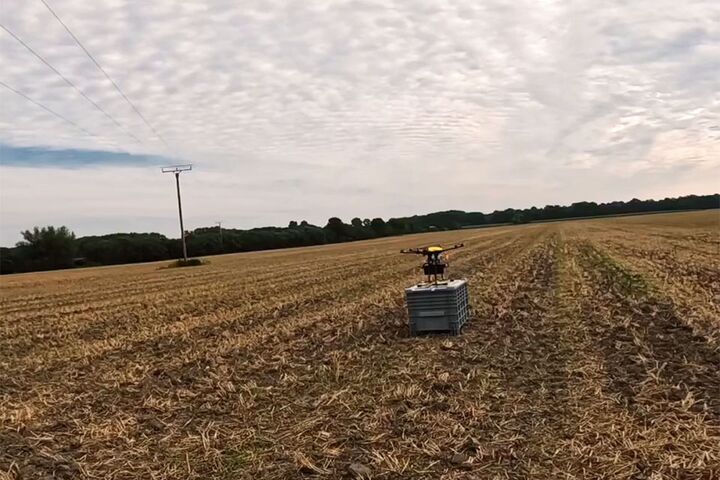
For Current Magnetometry Inspection (CMI), an inspection current is fed into the pipeline, and the drone carries the magnetic field sensors along the route at low altitude. EMPIT's drone, the Black Copter, detects the field of the inspection current and follows the pipeline route. It is equipped with GPS, LiDAR, radar and an inertial measurement unit.
The third generation of the drone, introduced in 2023, carries a payload of 25 kg with up to 70 tri-axial sensors and inspects at up to 5 km/h. From the air it delivers 3D mapping, depth of cover, bending strain and movement tracking, and evaluates coating condition and corrosion activity. EMPIT's Third-Generation CMI Drones and Technology give the details.
CMI uses the same measurement on every carrier. On open ground a technician walks the line with the handheld Current Mapper. Water crossings are surveyed by boat. The drone takes over where walking is slow, unsafe or impossible: steep slopes, wetlands and restricted areas.
Flights beyond visual line of sight need an approval from the aviation authority in most countries, which is part of the planning.
Yes. Drones with laser-based methane sensors or optical gas imaging cameras locate gas leaks along a pipeline route.
Yes, with magnetic field sensors. EMPIT's Black Copter carries the CMI sensor array and measures the magnetic field of an inspection current in the buried pipe from the air.
None in practice. UAV stands for unmanned aerial vehicle, UAS for the whole system including the ground station. Drone is the everyday word.
It depends on the country and the type of flight. Flights beyond visual line of sight and flights over people generally need an approval.
If you want to know whether a drone survey fits your route, send us the length, diameter and location of the pipeline. We tell you whether CMI fits and what a pilot section would look like.
Sources
Read more
28. August 2023
21. November 2026
We use cookies to give you the best possible experience on our website and to improve our communication with you. We only use the data for which you have given us your consent, with the exception of the cookies that are absolutely necessary for the functionality of this website. For more information, please see our privacy policy. Make your choice here:
You can change your consent at any time by clicking on the Cookie Settings link in your footer.
Protects against cross-site request forgery attacks.
Saves the current PHP session.
Cookie from Google for website analytics. Generates statistical data about how visitors use the website. https://policies.google.com/privacy?hl=de