
NEW: Onshore Inspections
The Flux
A robust handheld system for corrosion detection and 3D mapping of unpiggable pipelines.
Discover the Flux
Inspect The Unpiggable
NEW: Onshore Inspections
A robust handheld system for corrosion detection and 3D mapping of unpiggable pipelines.
Discover the Flux →
NEW Service
Know how fast every coating defect corrodes, in µm/year, validated against excavations.
See how it works →
FREE: Whitepaper
How CMI separates protected steel from actively corroding steel, without excavation.
Download →A pipeline current mapper (PCM) is a handheld instrument for the AC current attenuation survey of buried pipelines. A transmitter applies a low-frequency signal to the pipe, and the receiver measures from above ground how much of that current is still flowing at each point. Sections where the current drops quickly have a coating in poor condition or a contact to another metallic structure. The name comes from the PCM product line of Radiodetection. In the field it is often used for the method as well.
On this page
At a glanceHow it worksUseLimitsPCM and CMIFAQ
| Method | AC current attenuation survey, also called ACCA or current attenuation method (CAM) |
| Signal | A low-frequency signal of 4 Hz from a transmitter connected to the pipeline |
| Measured | The signal current in mA at points along the line, plus the position and depth of the pipe |
| Shows | Coating condition by section, coating faults and contacts to other metallic structures |
| Add-on | An A-frame for ACVG, to pinpoint individual coating faults |
| Standard | AMPP (NACE) TM0109, AC attenuation survey |
| Does not show | Whether the steel at a coating fault is corroding |
The transmitter is connected to the pipeline and to ground and applies a 4 Hz signal. The operator walks the line with the receiver, locates the pipe and takes a current reading at regular intervals.
On a well-coated pipe the signal weakens slowly and evenly. Where the coating is damaged, or where the pipe touches another metallic structure, current leaves the pipe and the reading drops in a step. The survey narrows the fault down to a section.
To pinpoint the fault, an A-frame is connected to the receiver. It measures the voltage gradient in the soil, which is an ACVG survey. Arrows on the display point towards the fault.
A PCM survey is a coating survey. It describes how much signal current the coating lets through. It does not show whether the steel at a fault is protected or corroding, and it gives no corrosion rate.
According to TM0109, the AC attenuation survey assesses the coating section by section and is not typically effective in identifying individual holidays.
The readings are current values at single points. Where other signals interfere, they fluctuate. The survey therefore finds the section with a fault, and the A-frame the exact spot.
The names are similar, and the principle is related. Both apply an AC signal to the pipe and measure the magnetic field of the current from above ground. EMPIT's Current Magnetometry Inspection (CMI) is a current attenuation method as well. The difference is the measurement grid.
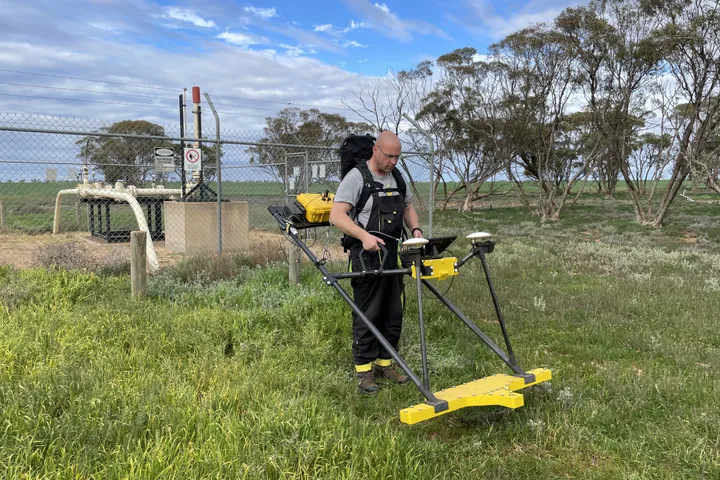
A PCM survey takes current readings at intervals along the line and rates the coating section by section. CMI records the signal on a 1 cm grid with the Current Mapper. A multi-frequency analysis then evaluates every coating defect.
The results of CMI: every coating defect located, down to less than 1 mm², a corrosion rate in µm per year for each one, and the 3D position of the pipe with depth of cover and bending strain.
EMPIT can record ACVG and CIPS in the same survey as CMI.
Pipeline current mapper. It is the name of an instrument from Radiodetection for AC current attenuation surveys and is often used for the survey itself.
The mapping signal has a frequency of 4 Hz. Additional locate frequencies help to trace the pipe.
No. The PCM survey measures the signal current in the pipe. ACVG measures the voltage gradient in the soil at a coating fault. With an A-frame, the same instrument can do both.
No. The Current Mapper is the handheld sensor unit of Current Magnetometry Inspection (CMI). CMI also works with current attenuation, but records the signal on a 1 cm grid. It locates individual coating defects and gives a corrosion rate for each one.
If you want to know what an above-ground inspection would show on your line, send us the length, diameter and location of the pipeline. We will tell you whether CMI fits and what a pilot section would look like.
Sources
Read more

02. August 2023
We use cookies to give you the best possible experience on our website and to improve our communication with you. We only use the data for which you have given us your consent, with the exception of the cookies that are absolutely necessary for the functionality of this website. For more information, please see our privacy policy. Make your choice here:
You can change your consent at any time by clicking on the Cookie Settings link in your footer.
Protects against cross-site request forgery attacks.
Saves the current PHP session.
Cookie from Google for website analytics. Generates statistical data about how visitors use the website. https://policies.google.com/privacy?hl=de