
NEW: Onshore Inspections
The Flux
A robust handheld system for corrosion detection and 3D mapping of unpiggable pipelines.
Discover the Flux
Inspect The Unpiggable
NEW: Onshore Inspections
A robust handheld system for corrosion detection and 3D mapping of unpiggable pipelines.
Discover the Flux →
NEW Service
Know how fast every coating defect corrodes, in µm/year, validated against excavations.
See how it works →
FREE: Whitepaper
How CMI separates protected steel from actively corroding steel, without excavation.
Download →External corrosion direct assessment (ECDA) is a four-step process for evaluating the threat of external corrosion on a buried pipeline: preassessment, indirect inspection, direct examination and post assessment. It combines pipeline records, above-ground surveys and targeted excavations. In the US integrity management rules it is one of three accepted assessment methods, next to in-line inspection and pressure testing. Operators use it mainly where no inspection tool can pass through the line.
On this page
At a glanceThe four stepsIndirect inspectionLimitsECDA with CMIFAQ
| Stands for | External corrosion direct assessment |
| Defined in | AMPP (NACE) SP0502. In the United States required by 49 CFR 192.925 for gas and 49 CFR 195.588 for liquid pipelines |
| Steps | Preassessment, indirect inspection, direct examination, post assessment |
| Threat covered | External corrosion only. Internal corrosion and stress corrosion cracking have their own direct assessment processes, ICDA and SCCDA |
| Indirect inspection | At least two different but complementary above-ground tools for each ECDA region |
| Typical use | Unpiggable pipelines, and lines where a pressure test would interrupt supply |
The regulation asks for at least two different but complementary tools in each region. Common choices are the close-interval potential survey (CIPS), DCVG, ACVG and the AC current attenuation survey.
CIPS shows the level of cathodic protection along the line. The voltage gradient surveys locate individual coating holidays. The current attenuation survey rates the coating section by section.
ECDA does not inspect the pipe wall. It infers the condition of the steel from surveys at the surface and confirms it at a small number of excavations.
The classic indirect inspection tools locate coating damage and measure potentials. They do not show whether the steel at a coating holiday is corroding. The ranking of excavations therefore follows the coating indication, not the corrosion activity, and every excavation that finds intact steel costs money without reducing risk.
Two tools that both depend on the voltage gradient at the soil surface also share a blind spot: small gradients go undetected by both.
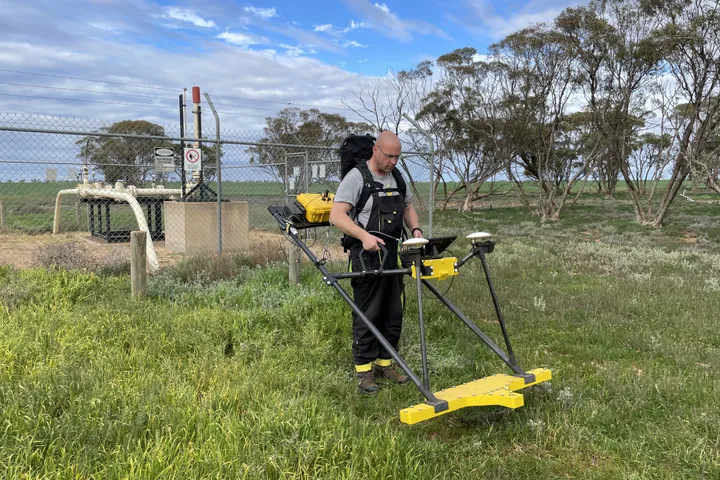
EMPIT's Current Magnetometry Inspection (CMI) builds on a technique that the ECDA process already knows: the AC current attenuation survey, also called ACCA or current attenuation method (CAM). An inspection current is fed into the pipeline, and its magnetic field is measured from above ground. Where the coating is damaged, part of the current leaves the pipe.
The difference is the measurement grid. A conventional current attenuation survey takes readings at intervals along the line and rates the coating section by section. CMI records the signal on a 1 cm grid. Individual coating defects become visible, and each one gets a corrosion rate in µm per year.
In an ECDA programme, operators use CMI as a complementary indirect inspection tool. EMPIT can record CIPS and ACVG in the same survey, so one field campaign covers several tools. The ranking of excavations can then follow corrosion activity instead of coating damage alone, and the measured rates are additional input for the reassessment interval.
Two data sets document the performance. In the DVGW research project NEMEK, CMI assessed the effectiveness of cathodic protection correctly in 94.6% of 37 excavations. In a blind test on a buried test spool, all 13 defects were found from the surface with no false calls. ECDA for Unpiggable Pipelines describes the fit step by step.
External corrosion direct assessment. It is a four-step process that evaluates the threat of external corrosion on a buried pipeline without an in-line inspection.
For the threat of external corrosion, yes. The US integrity management rules accept direct assessment next to in-line inspection and pressure testing. ECDA does not measure the pipe wall along the whole line the way an in-line inspection does.
At least two different but complementary tools for each ECDA region, according to 49 CFR 192.925.
ECDA covers external corrosion, ICDA internal corrosion and SCCDA stress corrosion cracking. Each is a separate direct assessment process.
If you are planning an ECDA on an unpiggable line, send us the length, diameter and location of the pipeline. We will tell you whether CMI fits as an indirect inspection tool and what a pilot section would look like.
Sources
Related terms
Unpiggable PipelineCIPSDCVGACVGCathodic ProtectionNACEIntegrity ManagementPipeline Casing
Read more

We use cookies to give you the best possible experience on our website and to improve our communication with you. We only use the data for which you have given us your consent, with the exception of the cookies that are absolutely necessary for the functionality of this website. For more information, please see our privacy policy. Make your choice here:
You can change your consent at any time by clicking on the Cookie Settings link in your footer.
Protects against cross-site request forgery attacks.
Saves the current PHP session.
Cookie from Google for website analytics. Generates statistical data about how visitors use the website. https://policies.google.com/privacy?hl=de