
NEW: Onshore Inspections
The Flux
A robust handheld system for corrosion detection and 3D mapping of unpiggable pipelines.
Discover the Flux
Inspect The Unpiggable
NEW: Onshore Inspections
A robust handheld system for corrosion detection and 3D mapping of unpiggable pipelines.
Discover the Flux →
NEW Service
Know how fast every coating defect corrodes, in µm/year, validated against excavations.
See how it works →
FREE: Whitepaper
How CMI separates protected steel from actively corroding steel, without excavation.
Download →A smart pig, also called an intelligent pig, is an instrumented tool that travels through a pipeline with the product and measures the pipe wall from inside. Smart pigs are the tools of in-line inspection (ILI). They need a piggable pipeline.
On this page
| Also called | Intelligent pig, ILI tool |
| Difference to a utility pig | A utility pig cleans the line or separates products. A smart pig records data |
| Technologies | Magnetic flux leakage, ultrasound, EMAT, caliper, inertial mapping |
| Driven by | The product flow |
| Needs | Launcher and receiver, passable bends and fittings, sufficient flow |
| Tool | Technology | What it finds |
|---|---|---|
| MFL pig | Magnetic flux leakage | Metal loss from corrosion |
| Ultrasonic pig | Ultrasonic wall thickness measurement, needs a liquid around the sensors | Metal loss and laminations, with crack tools also cracks |
| EMAT tool | Electromagnetic acoustic transducers, work in gas without a liquid | Cracks such as stress corrosion cracking, disbonded coating |
| Caliper pig | Mechanical arms or sensors that measure the bore | Dents, ovality, wrinkles |
| Mapping tool | Inertial measurement unit (IMU) | Pipeline position and bending strain |
Combination tools carry several of these technologies in one run.
The tool is loaded into a launcher, driven through the line by the product flow and taken out at a receiver. Before the inspection run, cleaning pigs and often a gauge or caliper pig confirm that the line is clean and passable. After the run, analysts evaluate the recorded data and report features with their position, depth and length.
API Standard 1163 describes how in-line inspection systems are qualified and how their results are verified in the field.
A smart pig needs a line it can pass. Missing launchers, tight bends, diameter changes, unbarred tees and low flow keep it out of around 40% of the world's pipelines. On gas lines, ultrasonic tools need a liquid batch. And a pig measures the metal loss that has already happened. Whether a defect is still growing is derived from the comparison of two runs.
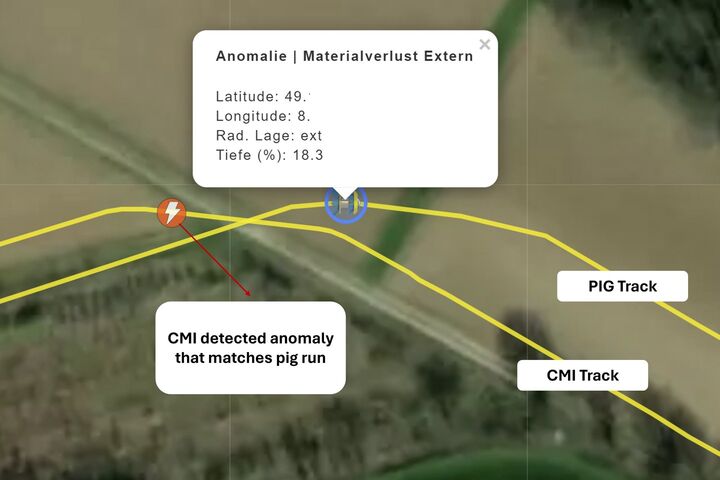
EMPIT's Current Magnetometry Inspection (CMI) inspects unpiggable pipelines from above ground. It locates every coating defect and gives a corrosion rate in µm per year for each one, together with the position of the pipe, the depth of cover and the bending strain. The two methods answer different questions: in-line inspection shows how much metal has been lost, CMI shows where corrosion is active. CMI vs. ILI compares them.
The origin is not certain. A common explanation is the squealing sound that early cleaning pigs made in the pipe. Pipeline inspection gauge is a later reading of the word.
A utility pig cleans the line or separates products. A smart pig carries sensors and records data about the pipe wall.
Depending on the technology: metal loss from corrosion, cracks, dents and other deformation, and the position and bending strain of the pipeline.
No. Around 40% of pipelines worldwide are unpiggable. They are inspected with other methods, for example with CMI from above ground.
If you want to know how a line without pig access can be inspected, send us the length, diameter and location of the pipeline. We tell you whether CMI fits and what a pilot section would look like.
Sources
Related terms
Inline Inspection (ILI)MFL PigUltrasonic PigCaliper PigPiggable PipelineUnpiggable PipelinePOD
Read more

We use cookies to give you the best possible experience on our website and to improve our communication with you. We only use the data for which you have given us your consent, with the exception of the cookies that are absolutely necessary for the functionality of this website. For more information, please see our privacy policy. Make your choice here:
You can change your consent at any time by clicking on the Cookie Settings link in your footer.
Protects against cross-site request forgery attacks.
Saves the current PHP session.
Cookie from Google for website analytics. Generates statistical data about how visitors use the website. https://policies.google.com/privacy?hl=de