
NEW: Onshore Inspections
The Flux
A robust handheld system for corrosion detection and 3D mapping of unpiggable pipelines.
Discover the Flux
Inspect The Unpiggable
NEW: Onshore Inspections
A robust handheld system for corrosion detection and 3D mapping of unpiggable pipelines.
Discover the Flux →
NEW Service
Know how fast every coating defect corrodes, in µm/year, validated against excavations.
See how it works →
FREE: Whitepaper
How CMI separates protected steel from actively corroding steel, without excavation.
Download →A magnetic flux leakage (MFL) pig is an in-line inspection tool that finds metal loss in a steel pipeline. Strong magnets magnetise the pipe wall, and sensors record where magnetic flux leaks out of the wall because metal is missing. MFL is the most widely used technology for detecting corrosion from inside a pipeline.
| Detects | Metal loss from internal and external corrosion, gouges, some weld and mill features |
| Principle | Magnets saturate the wall, sensors measure the flux that leaks out at defects |
| Works in | Gas and liquid lines, no liquid needed around the sensors |
| Variants | Axial MFL, and circumferential MFL for narrow axial defects |
| Needs | A piggable pipeline |
Permanent magnets on the tool couple to the pipe wall through steel brushes and drive a magnetic field through it, strong enough to saturate the steel. In sound pipe, the flux stays inside the wall. Where the wall is thinner, the remaining steel cannot carry all the flux, and part of it leaks out on both sides of the wall.
Rings of sensors between the magnet poles, usually Hall sensors, record this leakage field around the whole circumference. Further sensors tell whether a defect is on the inside or on the outside of the wall.
MFL measures metal loss indirectly. Analysts derive the depth, length and width of each defect from the shape of the leakage signal, using sizing models that are calibrated on known defects. The report lists every metal loss feature with its position along the line, its clock position and its estimated depth in percent of wall thickness.
Tool performance is stated as a probability of detection and a sizing accuracy for defined defect types. API Standard 1163 describes how these specifications are qualified and verified.
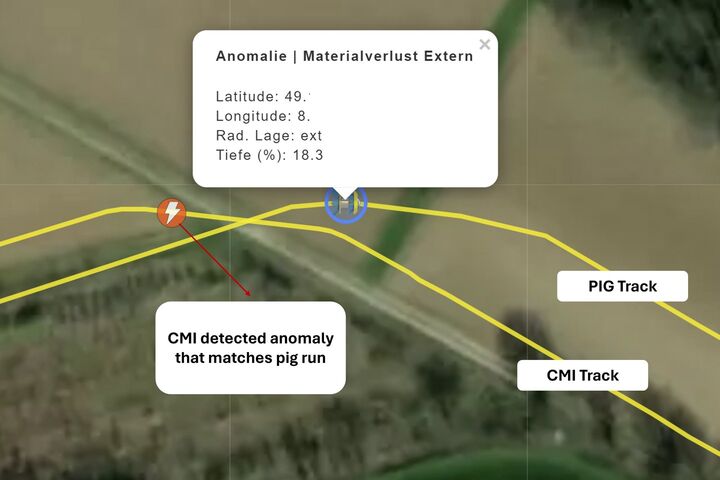
Where no MFL pig can run, EMPIT's Current Magnetometry Inspection (CMI) inspects the pipeline from above ground. CMI also measures a magnetic field, but that of an inspection current flowing in the pipe, not of a magnetised wall. It locates every coating defect and gives a corrosion rate in µm per year for each one. MFL shows how much metal has been lost, CMI shows where corrosion is active. CMI vs. ILI compares the two.
MFL stands for magnetic flux leakage, the magnetic field that leaks out of a magnetised steel wall where metal is missing.
Standard axial MFL tools are built for metal loss. Tight cracks need ultrasonic or EMAT crack detection tools. Circumferential MFL finds some axially oriented features.
An MFL pig infers metal loss from a magnetic leakage signal and works in gas and liquid lines. An ultrasonic pig measures the wall thickness directly and needs a liquid around the sensors.
No. An MFL pig has to travel through the line. Unpiggable pipelines are inspected with other methods, for example with CMI from above ground.
If you want to know how a line without pig access can be inspected, send us the length, diameter and location of the pipeline. We tell you whether CMI fits and what a pilot section would look like.
Sources
Read more

We use cookies to give you the best possible experience on our website and to improve our communication with you. We only use the data for which you have given us your consent, with the exception of the cookies that are absolutely necessary for the functionality of this website. For more information, please see our privacy policy. Make your choice here:
You can change your consent at any time by clicking on the Cookie Settings link in your footer.
Protects against cross-site request forgery attacks.
Saves the current PHP session.
Cookie from Google for website analytics. Generates statistical data about how visitors use the website. https://policies.google.com/privacy?hl=de