
NEW: Onshore Inspections
The Flux
A robust handheld system for corrosion detection and 3D mapping of unpiggable pipelines.
Discover the Flux
Inspect The Unpiggable
NEW: Onshore Inspections
A robust handheld system for corrosion detection and 3D mapping of unpiggable pipelines.
Discover the Flux →
NEW Service
Know how fast every coating defect corrodes, in µm/year, validated against excavations.
See how it works →
FREE: Whitepaper
How CMI separates protected steel from actively corroding steel, without excavation.
Download →An engineering critical assessment (ECA) is a calculation that decides whether a flaw in a structure is acceptable. It uses fracture mechanics to compare the size of the flaw and the stress acting on it with the toughness of the material. The result says whether the flaw can stay, how large it may become and how long that will take.
On this page
At a glanceHow it worksInputsFAQ
| Related term | Fitness-for-service (FFS) assessment |
| Inputs | Flaw size and position, stresses, material toughness and strength, load cycles |
| Results | Acceptable or not, critical flaw size, remaining life, inspection interval |
| Standards | BS 7910, API 579-1/ASME FFS-1, API 1104 for girth welds |
| Typical cases | Girth weld flaws, cracks, hydrogen conversion |
The assessment places the flaw in a failure assessment diagram. One axis shows how close the flaw is to brittle fracture, the other how close the remaining cross-section is to plastic collapse. A point inside the curve is acceptable. For growing flaws such as fatigue cracks the calculation is repeated cycle by cycle until the point reaches the curve. That gives the remaining life.
An ECA is only as good as its inputs. Flaw sizes come from inspection, material data from records and tests. The stresses are often the weakest part, because a buried pipeline carries loads that nobody designed: ground movement bends it, and the bending adds to the pressure.
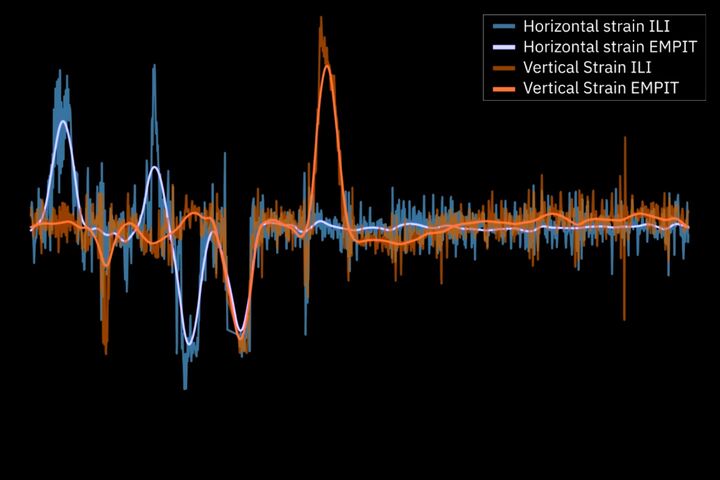
EMPIT's Current Magnetometry Inspection (CMI) measures the curvature of the line from above ground and derives the bending strain, which goes into the assessment as a load. This also works on unpiggable pipelines, where no inertial data from a pig are available.
Workmanship criteria accept or reject a flaw by fixed size limits. An ECA calculates for the specific case whether the flaw is safe, which often allows larger flaws to stay.
BS 7910 and API 579-1/ASME FFS-1 are the general standards. API 1104 contains an ECA route for pipeline girth welds.
When flaws are found that exceed the standard limits, when operating conditions change, or when a line is converted to hydrogen.
If you want to know which loads act on your line, send us the length, diameter and location of the pipeline. We will tell you whether CMI fits and what a pilot section would look like.
Sources
Related terms
Fatigue CracksTypes of CracksHydrogen ReadyBending StrainIntegrity ManagementRisk-Based Inspection
Read more
21. November 2026

We use cookies to give you the best possible experience on our website and to improve our communication with you. We only use the data for which you have given us your consent, with the exception of the cookies that are absolutely necessary for the functionality of this website. For more information, please see our privacy policy. Make your choice here:
You can change your consent at any time by clicking on the Cookie Settings link in your footer.
Protects against cross-site request forgery attacks.
Saves the current PHP session.
Cookie from Google for website analytics. Generates statistical data about how visitors use the website. https://policies.google.com/privacy?hl=de