
NEW: Onshore Inspections
The Flux
A robust handheld system for corrosion detection and 3D mapping of unpiggable pipelines.
Discover the Flux
Inspect The Unpiggable
NEW: Onshore Inspections
A robust handheld system for corrosion detection and 3D mapping of unpiggable pipelines.
Discover the Flux →
NEW Service
Know how fast every coating defect corrodes, in µm/year, validated against excavations.
See how it works →
FREE: Whitepaper
How CMI separates protected steel from actively corroding steel, without excavation.
Download →The flow rate is the volume of product that a pipeline transports per unit of time. Together with the pipe diameter it gives the flow velocity. For operation it is the measure of capacity. For inspection it matters because a pig travels with the flow and at its speed.
On this page
At a glancePiggingFrom above groundFAQ
| Given as | Volume per time, for example m³ per hour |
| Flow velocity | Flow rate divided by the cross-section of the pipe |
| For pigging | Every tool has a speed range in which its data are valid |
| Too low | The tool stalls or moves in jerks |
| Too high | The tool is too fast for its sensors, or the flow has to be reduced for the run |
An in-line inspection tool is pushed by the product. If the flow is too low, the pig stops at every obstacle until the pressure behind it builds up, then shoots forward. The data from such a run are of little use. If the flow is too high, the operator has to throttle the line for the run or use a tool with speed control, which costs transport capacity.
Lines with low, changing or no flow are therefore a large group among unpiggable pipelines: storage connections, station piping, branch lines and dead legs.
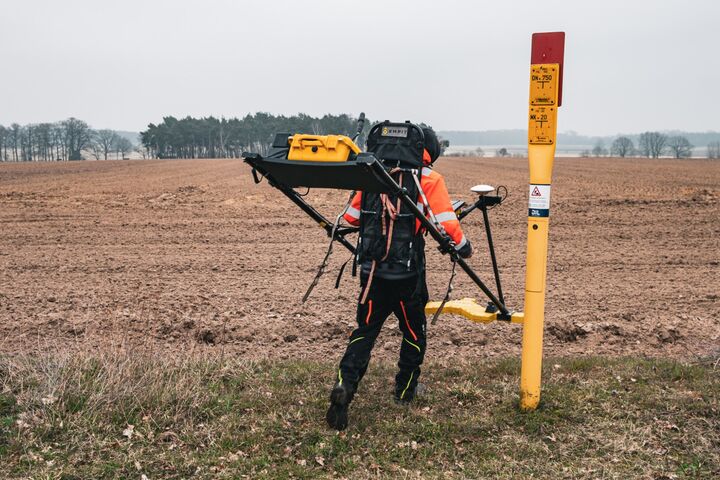
EMPIT's Current Magnetometry Inspection (CMI) does not need the flow. The survey is done from above ground, nothing enters the pipe, and the line stays in service as it is. It delivers every coating defect with a corrosion rate, the 3D position with depth of cover and the bending strain. See Unpiggable Pipeline Inspection from Above Ground.
At the speed of the product. Each inspection tool has a speed range given by its vendor, and the flow is adjusted to stay within it.
Often not with standard tools. The pig stalls and surges, and the data quality suffers. Such lines count as difficult to pig or unpiggable.
The flow rate is a volume per time. The flow velocity is the speed of the product, which follows from the flow rate and the pipe cross-section.
If you want to know what an above-ground inspection would show on your line, send us the length, diameter and location of the pipeline. We will tell you whether CMI fits and what a pilot section would look like.
Sources
Read more

We use cookies to give you the best possible experience on our website and to improve our communication with you. We only use the data for which you have given us your consent, with the exception of the cookies that are absolutely necessary for the functionality of this website. For more information, please see our privacy policy. Make your choice here:
You can change your consent at any time by clicking on the Cookie Settings link in your footer.
Protects against cross-site request forgery attacks.
Saves the current PHP session.
Cookie from Google for website analytics. Generates statistical data about how visitors use the website. https://policies.google.com/privacy?hl=de